StG 44: The Rifle That Changed Modern Warfare
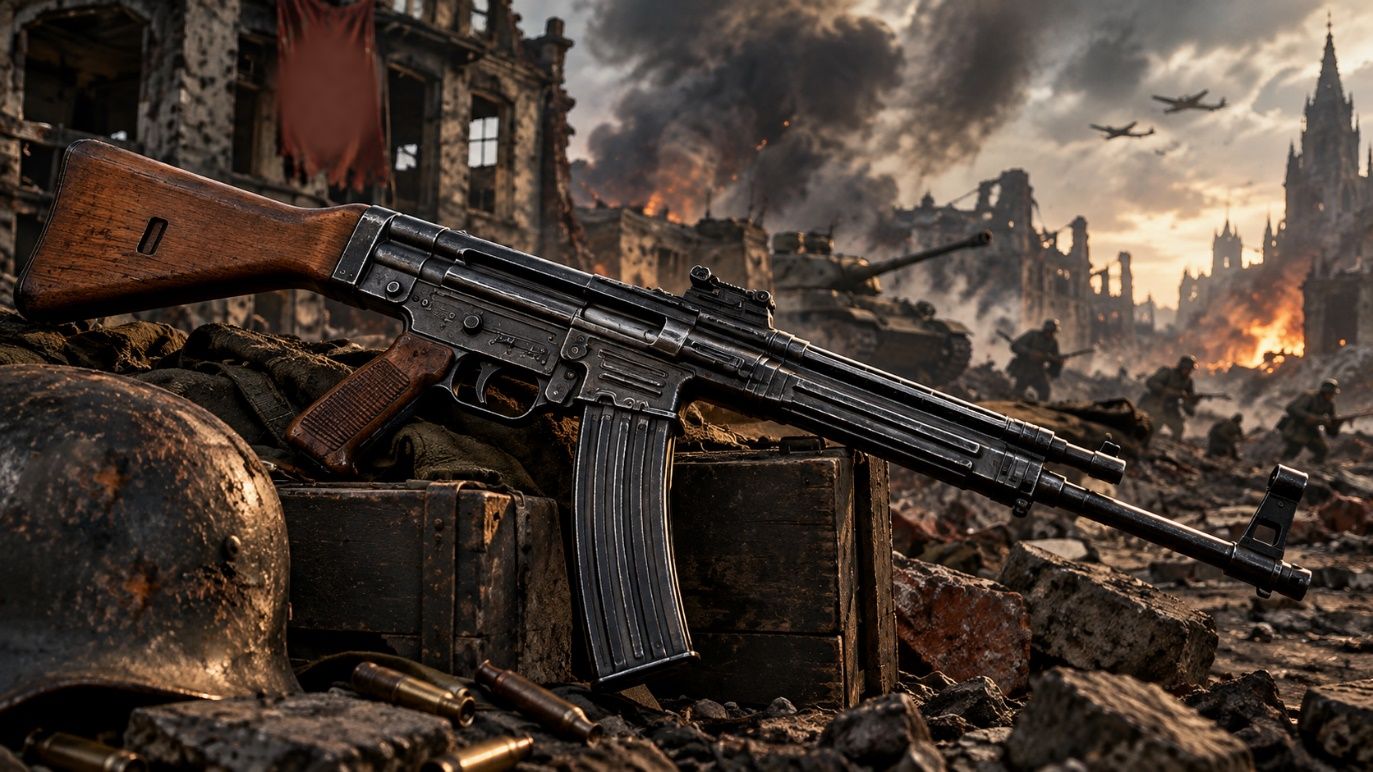
In the autumn of 1944, Nazi Germany was losing the war, yet a weapon appeared on the battlefield that looked like it had arrived from the future. It was the Sturmgewehr 44, literally "assault rifle," the name from which the term assault rifle comes, used today to describe an entire family of weapons. The rifle did not save the Third Reich, but it effectively ended the era of the heavy, long-range bolt-action rifle as the infantry's primary weapon.
How the Idea Was Born
From the experience of both world wars, the German army learned an uncomfortable truth: most combat happens at short range, often under 300 meters. The famous Karabiner 98k fired a powerful cartridge with a reach far beyond what a soldier needed in most situations, and it was slow to reload after every shot. Submachine guns such as the MP 40 were fast but had very short range.
The solution lay in the middle ground: an intermediate-power cartridge that was effective over several hundred meters, fired from a compact semi-automatic or fully automatic weapon. This led to the 7.92×33mm Kurz ("short") cartridge, shorter and lighter than the standard rifle round, with gentler recoil.
Advertisement
Timeline
Late 1930s — Development of the short cartridge and the start of the "machine carbine" (Maschinenkarabiner) program.
1941–1942 — Competition between Haenel (led by designer Hugo Schmeisser) and Walther; Haenel's design won as the MKb 42(H).
1943 — The name MP 43 was adopted to sidestep opposition from leadership, and field trials began on the Eastern Front.
1944 — Large-scale production under the name MP 44, then StG 44.
1945 — Roughly 400,000 produced (estimates vary), but the war was over.
Hitler was initially hesitant or opposed, citing supply complications and fears of disrupting the ammunition chain. After positive reports from the front, his position changed. The name "Sturmgewehr" is attributed to Hitler himself in propaganda accounts, but historians treat that claim with caution.
Design
Cartridge: 7.92×33mm Kurz. Operation: gas-operated, with a piston under the barrel and a tilting bolt. Fire modes: semi-automatic and fully automatic. Weight: about 5.2 kg unloaded. Length: about 94 cm. Magazine: 30-round curved box magazine, often loaded with fewer rounds to extend spring life. Effective range: about 300 meters. Rate of fire: about 500–600 rounds per minute.
The real innovation was not only the cartridge but the manufacturing. The designers relied on stamped steel instead of costly machining of solid parts. This cut cost and time and allowed production at multiple factories (Haenel, Erma, Steyr, Sauer & Sohn). The price was a rifle that looked rougher than classic rifles.
Unusual Accessories
Krummlauf (Vorsatz J): a barrel curved at about 30° for firing around corners from inside an armored vehicle or behind cover. It did not last long because of rapid barrel wear.
ZG 1229 Vampir: an infrared night-vision sight, produced in very small numbers and among the first combat night-vision devices.
Battles Where It Fought
The StG 44 was not the weapon of a single battle but of the final phase of the war: the Eastern Front (1943–1945), where its impact was clearest in close-quarters fighting; Normandy and Western Europe (1944), in the hands of elite units and paratroopers; the Battle of the Bulge (December 1944), Germany's last major offensive; and the final urban battles around Berlin, where it outperformed longer weapons.
Who Used It?
Elite units such as the Waffen-SS, paratroopers (Fallschirmjäger), and Panzergrenadier divisions carried it, along with Volksgrenadier divisions reformed in late 1944 and equipped with high-volume automatic weapons to compensate for a shortage of trained soldiers. After the war, armies and armed groups used captured or later-produced rifles, including in East Germany and the former Yugoslavia, with examples appearing in later conflicts according to field reports.
Combat Effectiveness
Strengths: far greater volume of fire than bolt-action rifles, lighter recoil that made automatic fire easier to control, and a good fit for forests, cities, and trenches. Soldiers and opponents alike acknowledged that it changed the way fighting was done.
Weaknesses: heavier than expected for an assault weapon, delicate magazines that needed care, a high line of sight that made the shooter raise his head more when prone, and a shorter reach than traditional sniper rifles. The biggest problem was timing — it arrived late and in insufficient numbers, as supply and fuel collapsed. In short, the rifle was technically successful but strategically late.
Influence on Modern Weapons
This is the most important part of its legacy. The StG 44 proved in practice that the intermediate cartridge was the future. The Soviet AK-47 (1947) adopted the same concept with the 7.62×39mm cartridge; Kalashnikov maintained that his design was independent, while some historians see an influence at the level of the general concept, noting that the German designer Schmeisser worked in the Soviet Union after the war. NATO rifles later moved to the smaller 5.56mm cartridge, applying the same idea in a lighter form. Stamped-steel manufacturing became a global method for cutting cost and speeding up production, and the curved magazine, selective fire control, and the combination of compact size with intermediate power all became the standard for infantry rifles to this day.
Conclusion
The StG 44 was not merely a German rifle in a lost war; it was a turning point in the philosophy of arming infantry. Every soldier carrying a modern assault rifle today walks, without knowing it, on the path paved by this stamped-steel weapon eighty years ago.