AK-47 vs. M16: Two Rifles, Two Philosophies of War
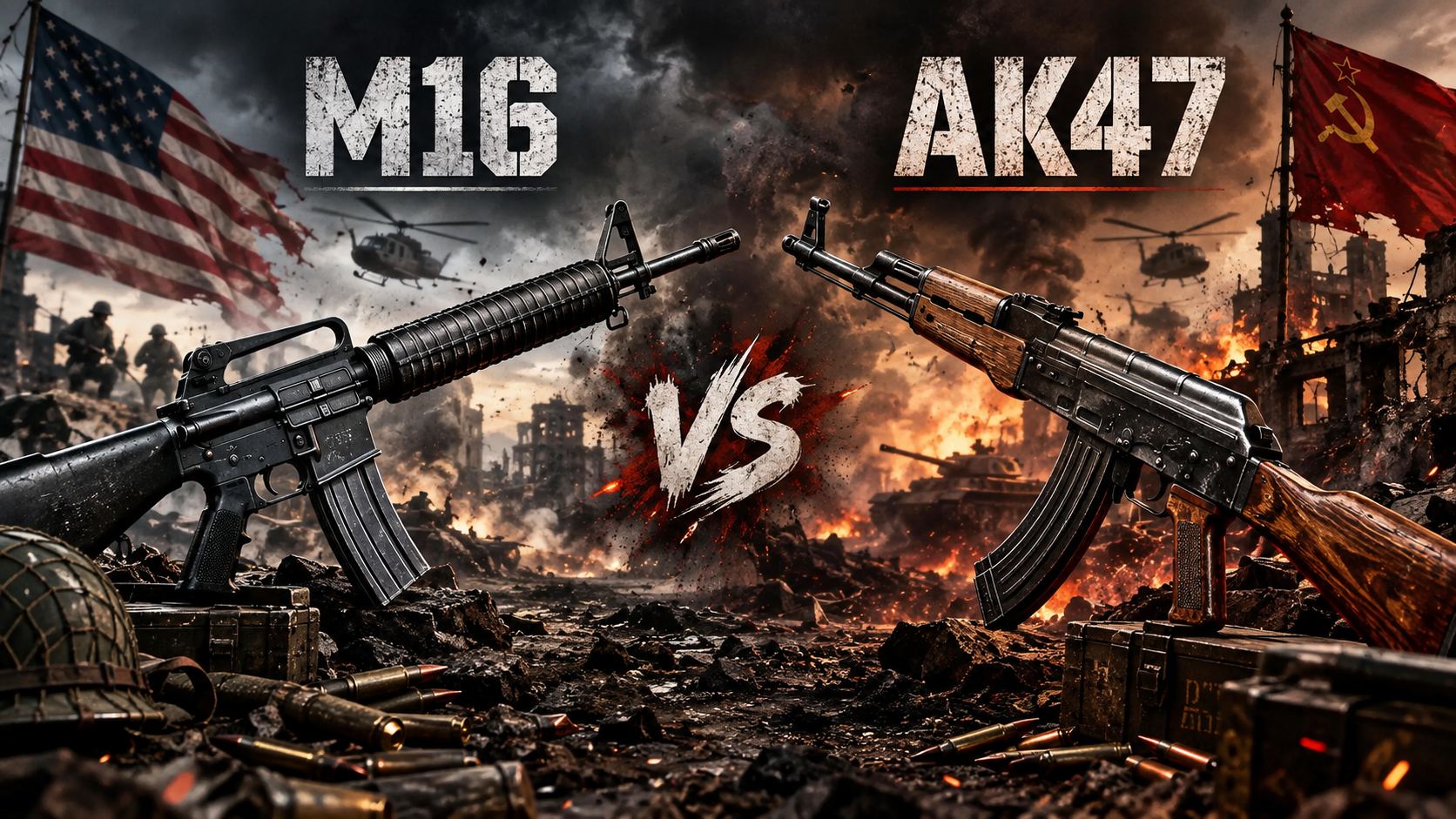
Few objects in the modern world are as instantly recognizable as the AK-47 and the M16. One is the rifle of mass armies, insurgents, and revolutions. The other is the rifle of precision engineering, accessories, and a whole industry built around customization. They were designed barely a decade apart, they fought each other in the jungles of Vietnam, and together they define what a modern infantry rifle is. But their stories reveal two opposite answers to the same question: what should a soldier's rifle be?
Origins: A Tank Sergeant and an Engineer
The AK-47. Mikhail Kalashnikov was a Soviet tank sergeant wounded during the Battle of Bryansk in 1941. While recovering, he began sketching small arms. By the end of the war, the Soviet Union already had a new intermediate cartridge, the 7.62×39mm, and was looking for a rifle to use it. After a series of design competitions in the mid-1940s, Kalashnikov's team produced the rifle that entered Soviet service around 1949 as the Avtomat Kalashnikova, model 1947, or AK-47.
The earliest versions used stamped sheet-metal receivers, but production difficulties pushed the Soviets to switch temporarily to milled receivers. It was only in 1959 that the AKM brought back stamped construction successfully, making the rifle lighter and even cheaper to build.
The M16. Eugene Stoner worked from the opposite end of the spectrum. At ArmaLite, he designed the AR-10 in the 1950s, a rifle built from aluminum alloys and modern synthetics. He then scaled it down into the AR-15, chambered in the small, fast .223 Remington round, later standardized as 5.56×45mm. Colt purchased the rights in 1959. The U.S. Air Force adopted the rifle in the early 1960s, and the Army followed, issuing it for Vietnam as the M16 by 1966.
Advertisement
Design: Tolerance vs. Precision
The AK-47 runs on a long-stroke gas piston, a stamped or milled steel receiver, and wood or polymer furniture, weighing about 4.3 kg unloaded and feeding from a 30-round curved magazine. The M16 uses direct gas impingement, an aluminum alloy receiver, and plastic furniture, weighing about 3 kg unloaded with a 20 or 30-round straight magazine.
The AK was built to keep working when neglected. Its loose internal tolerances let dirt, sand, and carbon pass through the action instead of jamming it. The M16 was built to be light, accurate, and easy to shoot. Its small, fast bullet produced low recoil, allowing soldiers to carry more ammunition and stay on target during automatic fire. The price was a more delicate mechanism that demands cleaning. In short: the AK trades finesse for reliability; the M16 trades some forgiveness for accuracy and ergonomics.
Battles That Defined Them
The AK-47 and its family appeared early in Hungary in 1956, then armed North Vietnamese and Viet Cong forces through the Soviet bloc and China. Israeli forces captured large numbers from their opponents in the Middle East wars, experience that led to the Israeli Galil, built on the Kalashnikov system. It has since appeared in nearly every major conflict of the last seventy years, from Afghanistan and Africa to the Balkans, Iraq, Syria, and Ukraine.
The M16 faced its first and most difficult trial in Vietnam, followed by larger conventional deployments in Grenada, Panama, and the Gulf War. In Iraq and Afghanistan it served mostly through the shorter, lighter M4 carbine, which grew out of the same design.
The Vietnam Problem
The M16 had a troubled start. In early service, many soldiers experienced jams in combat. The causes were a mix of factors: a change in the propellant powder used in the ammunition, a chamber that was not chrome-lined, and early messaging that described the rifle as nearly self-cleaning, so cleaning kits were not widely issued at first. Fixes followed quickly: the M16A1 in 1967 added a chrome-lined chamber and a forward assist, and proper training and cleaning gear were introduced. The episode became a lasting lesson in how a good design can fail if the human system around it is not prepared.
Who Carries Them?
The AK is the rifle of conscript armies, partisans, militias, rebel groups, and police forces; its simplicity means a recruit can be trained quickly. The M16 and its descendants are carried by professional, well-supplied militaries trained to maintain their equipment, alongside a vast civilian market for AR-15-style rifles in the United States. This difference shaped each rifle's reputation: the AK became a symbol of mass access, while the M16 became a symbol of modular, high-technology soldiering.
Combat Effectiveness
AK-47 strengths: exceptional reliability in harsh conditions, simple maintenance, strong penetration of light cover, low production cost. Weaknesses: heavier ammunition, more recoil, less accurate at longer range in automatic fire.
M16 strengths: light weight, low recoil, good accuracy, easy to mount optics and accessories. Weaknesses: greater sensitivity to dirt and neglect, a lighter bullet that can lose effectiveness at long range or through barriers.
Neither is "better" in the abstract. Each is better at the job its designers imagined.
Influence on Modern Weapons
Between them, these two rifles shaped almost every infantry weapon that followed. The M16's success pushed NATO toward 5.56mm in 1980, and the Soviet Union answered with the AK-74 (5.45×39mm) in the 1970s. The AK family tree runs from the AKM and AK-74 to the Galil, Finnish Valmet rifles, the Chinese Type 56, and the modern AK-12. The AR-15/M16 design became the foundation of the M4, many foreign rifles, and an industry of rails, optics, and interchangeable parts that modern customizable rifles trace back to directly. Both rifles ultimately share an ancestor: the intermediate-cartridge concept popularized by the German StG 44.