The V-2 Rocket
The weapon that opened the door to space and closed the door on innocence.
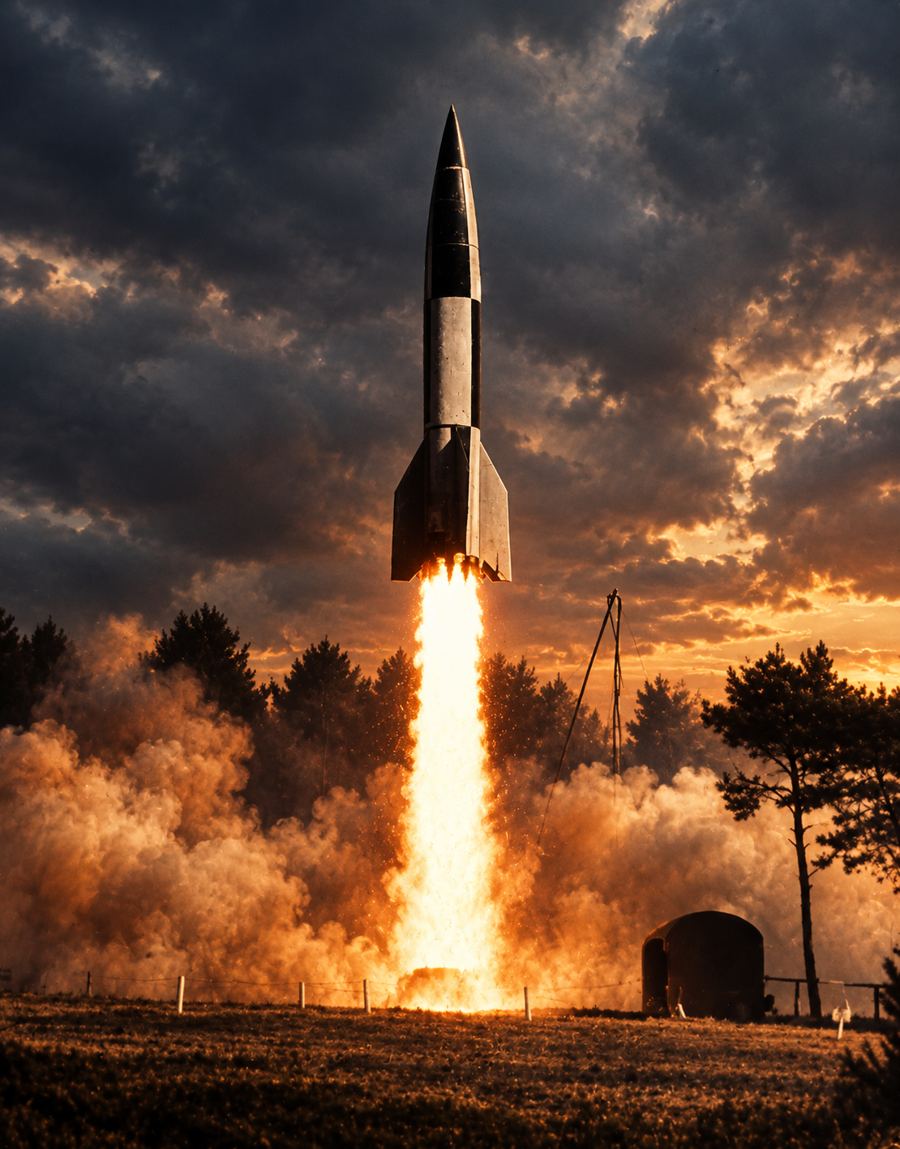
The Sound That Came Too Late
Imagine standing in a London street in the autumn of 1944. There is no air-raid siren. No drone of bombers overhead. Suddenly there is a flash, a violent blast, and a house a few streets away is simply gone. Only afterward, a few seconds later, comes a strange double crack and a rushing roar, the sound of something that had arrived faster than its own noise.
This was the V-2: the world's first long-range ballistic missile. Londoners and Belgians had learned to fear the buzz of the V-1 flying bomb, which gave at least some warning. The V-2 gave none. It climbed out of the atmosphere, arced over the English Channel, and fell back at several times the speed of sound. Nothing in 1944 could stop it.
It was also something else. For a few minutes of each flight, it passed the edge of space. The machine that terrorized cities was the ancestor of every rocket that has since carried humans to the Moon. That double legacy, wonder and horror welded into one steel body, is what makes the V-2 one of the most unsettling inventions of the twentieth century.
Advertisement
From Dreams of Space to a Weapon of War
The story begins with a teenager. As a boy in Germany in the 1920s, Wernher von Braun was gripped by the dream of spaceflight. He joined amateur rocket enthusiasts, read the visionary work of Hermann Oberth, and spent his days sketching engines. He was no villain at that age; he was a dreamer.
The trouble was money. Building rockets was costly, and the only patron able to pay was the army. After the Nazis came to power, the German military took an interest, and in the mid-1930s a vast secret research site rose at Peenemünde on the Baltic coast. The early rockets of the Aggregat series, A1 through A3, led to the A4. On 3 October 1942, after earlier failures, an A4 launched successfully, flew about 190 kilometers, and reached the upper edge of the atmosphere. One of the senior officers at the site reportedly said it marked the birth of the space age. He was right, though not in the way he hoped.
From there the program became a weapon. The propaganda ministry named it the “Vengeance Weapon 2”, and the rocket's purpose shifted from exploration to destruction.
How It Worked
| Specification | Details |
|---|---|
| Official designation | Aggregat 4 (A4); propaganda name V-2 (Vergeltungswaffe 2, “Vengeance Weapon 2”) |
| Developed at | Peenemünde, on the Baltic coast of Germany |
| Key figures | Wernher von Braun (technical director), Walter Dornberger (military head) |
| Length / launch weight | About 14 m long, about 12.5 tonnes at launch |
| Propellants | Liquid oxygen and an ethanol-water mixture |
| Warhead | About 1,000 kg of high explosive |
| Range | About 320 km |
| Peak altitude | Roughly 80–90 km (edge of space) |
| Flight time | About 5 minutes |
| Combat use | September 1944 – March 1945; over 3,000 launched |
The V-2's innovations were extraordinary for its time. A turbopump driven by steam from hydrogen peroxide forced alcohol and liquid oxygen into a powerful combustion chamber, producing around 25 tonnes of thrust. Gyroscopes guided it through the early part of its climb, and the engine shut down at a precise moment so the rocket would follow a ballistic arc toward its target. No pilot, no crew, no way to call it back.
In the field it was launched from mobile equipment, which let small crews fire from forests and roadsides and then disappear. A launch team of a few dozen men would fuel the rocket, check the systems, and fire within a couple of hours of arriving, before Allied aircraft could find them.
The Human Cost: Two Kinds of Victims
The V-2 killed on two fronts. The first was at the receiving end. Beginning on 8 September 1944, rockets struck London and later the Belgian port city of Antwerp, which took the heaviest toll. On 16 December 1944, a V-2 hit the Rex Cinema in Antwerp, killing hundreds of civilians and soldiers who had gone to see a film. In total, V-2 attacks killed an estimated several thousand people in Europe, and injured many more.
The second front was hidden underground. To build the rockets in mass, the Nazis moved production into a tunnel complex called Mittelwerk, near Nordhausen, using prisoners from the Mittelbau-Dora concentration camp as forced labor. The conditions were brutal, with starvation, disease, and executions. Historians estimate that around ten thousand or more prisoners died in connection with the program, a number comparable to, and by some estimates greater than, the number killed by the rockets themselves.
The rocket that reached for the stars was assembled by men who could not see the sky.
This is the part of the story that engineers' biographies often soften. It is also the part that readers deserve to know.
Battles and Targets
Opening strikes: First combat launches on 8 September 1944 against Paris and London.
Antwerp and other Belgian cities: Targeted heavily from October 1944 through March 1945, with many launches over the winter.
London: Thousands of rockets were aimed at London and the south-east of England until the launch sites were overrun.
Other targets: Some launches were directed at liberated French and Dutch towns and at Allied-held bridges, such as the Remagen bridge on the Rhine.
Who Served It
The V-2 was operated by specialized units of the German army and the SS, launched by men trained as rocket technicians. They were a very different kind of soldier: not riflemen but mechanics, electricians, and fuel handlers who worked in hurried, tense conditions, often under the threat of air attack. At the other end were scientists and engineers, many of them young, who had been drawn into the project by the thrill of rocketry and then found themselves unable to leave.
Combat Effectiveness
Strengths: Unstoppable with the technology of the time: no radar-guided interception, no fighter could catch it. Supersonic arrival gave no warning, producing deep psychological shock. Mobile launch crews were hard to find and destroy.
Weaknesses: Low accuracy: the missile could land several kilometers from its aim point, so it was effective only against large city targets. Small warhead for the cost: each rocket cost a great deal in materials and labor. Unreliable early on, with many failures on the launch pad or in flight. It arrived too late and in too small numbers to change the course of the war.
Militarily, the V-2 was a strategic disappointment. Technologically, it was a revolution.
Legacy: The Rocket That Built the Modern World
As the war ended, the Allies and the Soviet Union raced to capture the rocket's secrets. The United States brought hundreds of V-2 components and over a hundred German scientists, including von Braun, to America in what became known as Operation Paperclip. The Soviets seized factories and engineers too. The consequences are everywhere:
Intercontinental ballistic missiles: The V-2's engine and structure were studied by both superpowers and became the foundation of the Redstone, the R-1, and the long-range ballistic missiles of the Cold War.
The space race: Von Braun's team went on to build the Saturn V that carried astronauts to the Moon. The Soviet designer Sergei Korolev built on the same ideas to launch Sputnik and Yuri Gagarin.
Missile defense: The idea of a missile that cannot be intercepted during its flight led to entire industries of missile defense, early-warning radar, and space-based tracking.
Modern rockets: Today's launch vehicles, satellites, and long-range missiles all use the V-2's basic architecture: a liquid-fueled engine, turbopumps, gyroscopic guidance, and a ballistic trajectory.
Conclusion: Two Truths at Once
The V-2 is difficult to summarize because it asks us to hold two truths at the same time. It was a landmark of human engineering, the first object made by people to reach space. It was also a weapon built with forced labor to kill civilians. Remembering only the first erases the victims; remembering only the second ignores what the technology became.
Every time a rocket lifts off today, carrying satellites, scientists, or astronauts, it carries a trace of that history. The best way to honor it is to tell it in full.