The Browning Automatic Rifle: The Heavy Gun That Rode with the Squad for Half a Century
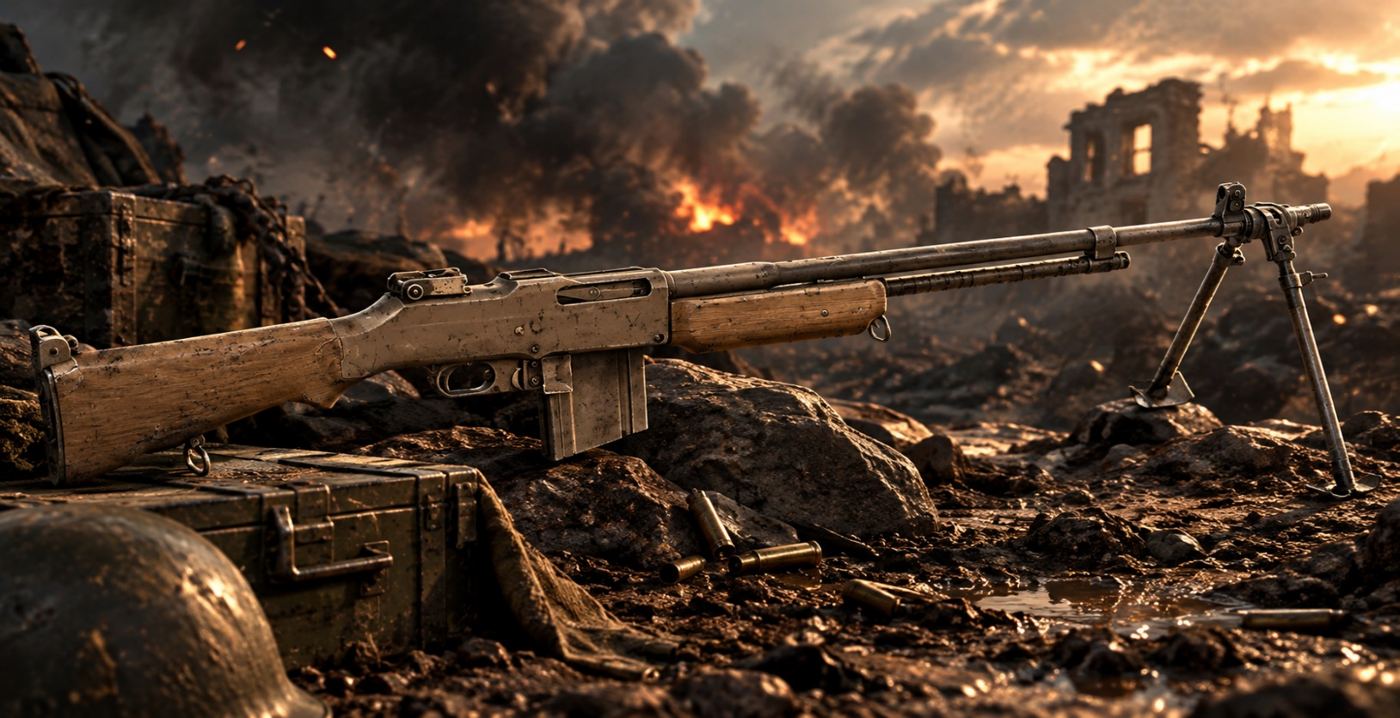
A Gun for the Man Who Had to Keep Walking
Imagine a gray morning in the autumn of 1918, somewhere in the broken woods of the Argonne. A young American soldier, perhaps nineteen, perhaps a farm boy who had never seen the ocean before the troopship, crouches behind a stump. Ahead of him lies open ground, barbed wire, and German machine guns. Behind him are his comrades, waiting for the signal to stand and advance. On his shoulder is a rifle that weighs more than anything he ever carried on the farm, and on his belt are pockets stuffed with heavy steel magazines.
He is the BAR man. When the squad moves, his gun is supposed to keep the enemy's heads down. For the next few minutes, a lot of men's lives depend on whether he can carry this weapon far enough, and whether it keeps firing.
The Browning Automatic Rifle, officially the M1918, was one of the most beloved and most argued-about infantry weapons of the 20th century. It was never quite a rifle and never quite a machine gun. It lived in the space in between, and its story is as much about the soldiers who carried it as about its steel.
Advertisement
Born from a Problem: Walking Fire
When the United States entered the First World War in 1917, American commanders faced a grim picture. The war on the Western Front had settled into trenches and machine-gun fire, and attackers were being cut down as they crossed open ground. The French and the British had developed ideas to help infantry push forward under fire. One of them, “walking fire”, imagined soldiers advancing at a steady pace while firing automatic weapons from the hip or shoulder, forcing defenders to keep their heads down.
The French light automatic weapon of the time, the Chauchat, was already in American hands, but it earned a bitter reputation. Soldiers complained that it jammed, that its magazines were flimsy, and that it failed when they most needed it. America needed a better answer, and it turned to the man who had already designed some of its best weapons: John Moses Browning.
Browning, a quiet gunsmith's son from Ogden, Utah, had a gift for turning complicated ideas into rugged machines. In 1917 he put forward a design that matched the new doctrine: a gas-operated, magazine-fed rifle that could fire automatically but was light enough for one man to carry. It was adopted as the M1918 and built by Winchester, Colt, and Marlin-Rockwell, with tens of thousands produced for the war effort.
How It Works
| Feature | M1918 | M1918A2 (1940) |
|---|---|---|
| Cartridge | .30-06 Springfield | .30-06 Springfield |
| Operation | Gas-operated, air-cooled | Gas-operated, air-cooled |
| Fire modes | Semi-automatic and full-automatic | Full-automatic only (two rates) |
| Rate of fire | About 500–650 rounds/min | About 300–450 (slow) or 500–650 (fast) |
| Magazine | 20-round detachable box | 20-round detachable box |
| Weight (unloaded) | About 7.2 kg (15.5 lb) | About 8.8 kg (19.4 lb) |
| Support | None (sling, hip or shoulder) | Folding bipod, flash hider, monopod on stock |
The BAR used the powerful .30-06 Springfield round, the same cartridge as the standard rifle, which gave it real hitting power and range. It operated by tapping gas from the barrel to cycle the action, a robust principle that Browning had refined over many years. A 20-round box magazine fed the gun. The ammunition belt issued with it held a dozen of these magazines, about 240 rounds in all, and every pound of that ammunition had to be carried on the soldier's body.
That is the BAR's first lesson. A gun like this is not just a mechanism; it is a load on a man's back. At around 15 pounds unloaded, it was far heavier than the soldier's rifle, and in the field it grew heavier with every magazine. The later M1918A2 version, introduced just before the Second World War, added a bipod and a shoulder support to make it steadier, which also made it heavier still.
Into the Fire: From the Argonne to the Pacific
The First World War. The BAR reached France in September 1918 and saw combat in the Meuse-Argonne Offensive, the largest American operation of the war. For the men who used it, it was a revelation after the Chauchat. It was far from perfect, but it kept firing, and that made all the difference. Only a limited number saw action before the Armistice in November.
The interwar years. After the war, the BAR became a fixture of the small, peacetime American army. It also drifted into a very different story. In the early 1930s, some of the most notorious outlaws of the Depression, including Clyde Barrow of the Bonnie and Clyde gang, stole BARs from National Guard armories. The gun that was meant to protect soldiers was now terrifying small-town police officers, who found themselves hopelessly outgunned. This was one reason the weapon became a symbol of firepower in popular memory.
The Second World War. In the Second World War, the BAR became standard in the American infantry squad, which typically had one automatic rifleman along with riflemen armed with the semi-automatic M1 Garand. It fought on the beaches of Normandy, in the hedgerows of France, in the forests of the Hürtgen, in the Italian mountains, and across the Pacific islands with the Army and the Marine Corps. In the jungle, soldiers often valued its stopping power and reliability, even as they complained about its weight.
Korea, Vietnam and beyond. The BAR stayed in service during the Korean War, where cold and mud tested every weapon. Some remained in use in Vietnam, mostly with allied South Vietnamese forces, and the type served many other countries for decades. By the 1960s the United States was moving on, but few weapons in American history have had such a long working life.
The Men Who Carried It
The BAR man was a distinct figure in the squad. He was usually among the strongest, since the gun was heavy and the ammunition heavier. He was also an obvious target: enemy soldiers learned quickly that taking out the automatic rifleman could break the squad's firepower. An assistant often carried extra magazines and was ready to take over if the gunner fell.
This human reality was built into the gun's design. A fixed barrel could not be changed in the field, so long bursts brought overheating. A 20-round magazine meant the soldier had to reload often. The BAR man learned to fire short, controlled bursts and to keep moving. It was a weapon that demanded discipline, and it often rewarded the men with the steadiest nerves.
For a nineteen-year-old in a muddy field, the BAR was less a piece of steel than a promise: that when the squad stood up and walked into the fire, someone would be shooting back.
There is also a quiet sadness in the story. John Browning, the man behind the gun, died in November 1926 while working at the Fabrique Nationale factory in Belgium, still designing weapons to the end of his life. He did not live to see the BAR carried across Normandy or the Pacific, yet his work would help shape the ordinary soldier's war for generations.
Combat Effectiveness
Where it excelled: a powerful .30-06 round with good range and penetration; a rugged, dependable mechanism in mud, cold, and dust; a small squad's own base of automatic fire, a big step beyond the single-shot rifle; and versatility in assault, defense, or ambush.
Where it struggled: it was heavy and tiring to carry over long distances, held only 20 rounds per magazine so sustained fire was limited, had a fixed barrel that overheated in extended firing, and could not match the sustained firepower of belt-fed machine guns such as the German MG 34 and MG 42.
In practice, it filled a gap. It was more powerful than a submachine gun and more mobile than a heavy machine gun. Not perfect at either job, it was good enough at both to remain in demand.
Legacy: The Idea That Never Went Away
The BAR's real legacy is conceptual. It established the idea of the squad automatic weapon, a machine that gives a small team its own source of sustained fire. That idea continues today.
Squad automatic weapons: the lightweight belt-fed M249 SAW and the FN Minimi that inspired it trace their purpose directly to the BAR's role in the infantry squad.
FN and Browning designs: the Browning gas-operated principle and the design experience gained from the BAR influenced later Browning and FN designs, including the Belgian FN Model D light machine gun.
The return of the magazine-fed automatic rifle: the modern U.S. Marine Corps Infantry Automatic Rifle, a magazine-fed weapon meant to be lighter than a belt-fed gun, revived the same trade-off the BAR faced a century earlier.
International copies: many nations built their own versions of the BAR concept, including Poland, Sweden, and Belgium, showing how widely the idea spread.
Conclusion: A Workhorse with a Human Face
The Browning Automatic Rifle never had the glamour of a sleek assault rifle or the legend of a giant cannon. It was a heavy, practical tool that helped ordinary men do an extraordinarily difficult job. It carried the hopes of tired squads across muddy fields and island jungles, and it taught armies something that remains true today: a weapon is only as good as the person who has to carry it.