Schwerer Gustav: The Largest Gun Ever Fired in Anger
And the men who lived in its shadow.
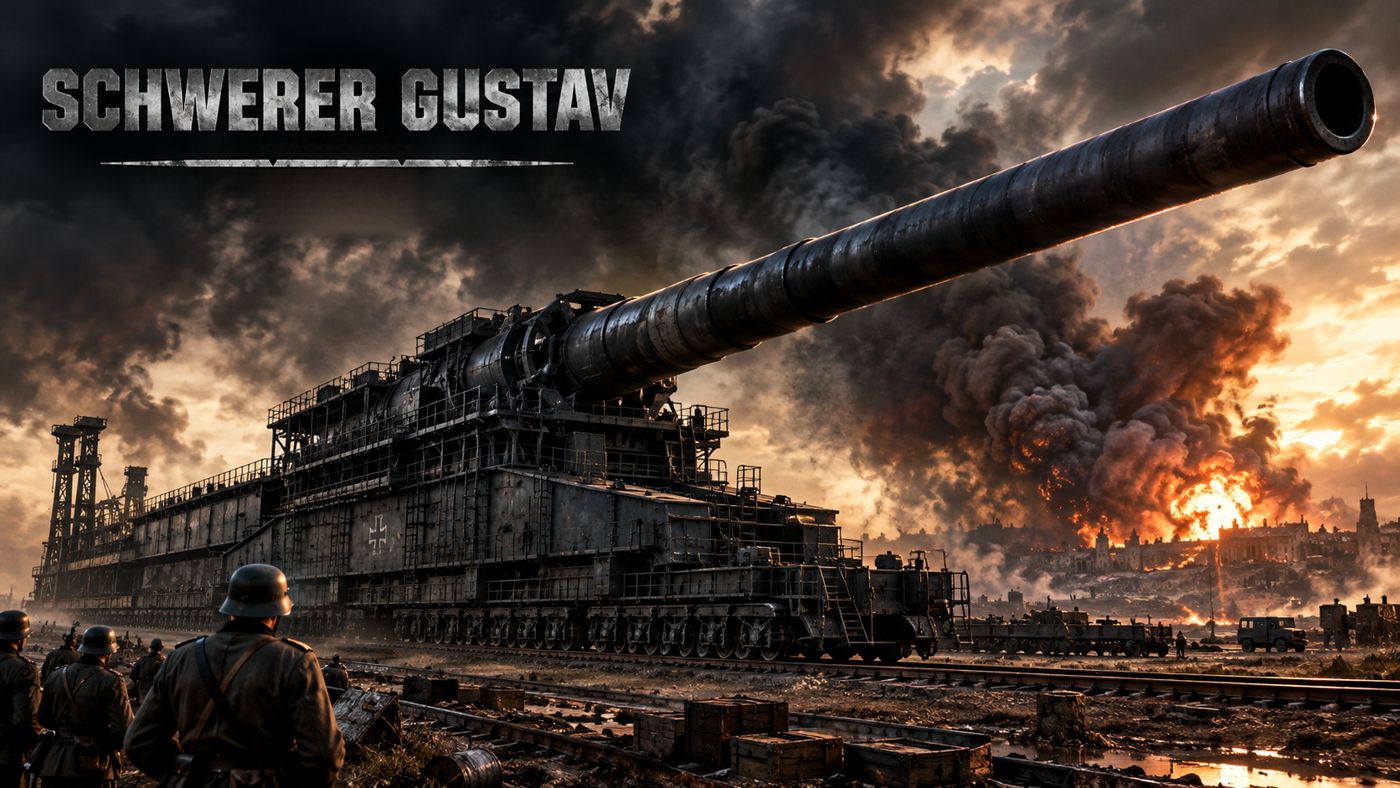
A Cannon the Size of a Building
Picture a railway station in the Crimean countryside in the spring of 1942. A freight train pulls in, then another, then dozens more. Out of the wagons come steel girders, gun parts as heavy as locomotives, cranes, rails, and thousands of weary soldiers. For weeks they work in the dust and heat, laying track in a special pattern and bolting together a machine that, once assembled, stands as tall as a three- or four-story building and stretches nearly half the length of a football pitch.
This was Schwerer Gustav, “Heavy Gustav”: a gun with a barrel almost 32 meters long, firing shells that weighed as much as a small truck. It was the biggest-caliber rifled weapon ever used in combat. It was also, in many ways, one of history's most spectacular misjudgments: an engineering triumph that arrived too late, cost too much, and changed too little.
Advertisement
Born from a Wall of Concrete
The story begins not with Hitler's ambitions in the east but with a wall in the west: the Maginot Line, France's chain of underground forts, bunkers, and tunnels built after the First World War. German planners knew that breaking through this line with ordinary artillery would be slow and bloody. In the mid-1930s the army asked the Krupp works in Essen for something extraordinary: a weapon capable of smashing the thickest fortifications from a safe distance.
Krupp, a family firm that had been forging Germany's cannons since the 19th century, took up the challenge. The engineers worked under the direction of Erich Müller, and the design was named “Gustav” after Gustav Krupp von Bohlen und Halbach, the head of the company. A second gun was built as well, called “Dora”, a name often said to honor Müller's wife. Imagine the strange mix of pride and unease in those drawing offices: a team of experienced engineers, many of them proud craftsmen, building something whose only purpose was to destroy on a scale never attempted before.
But the timeline slipped. The first gun was completed only in 1941, tested on a proving ground, and delivered to the army in early 1942. By then France had already fallen, in 1940, without anyone needing the monster. The weapon built to break the Maginot Line never saw it.
Anatomy of a Giant
| Specification | Details |
|---|---|
| Official name | 80 cm Kanone (E) “Schwerer Gustav” |
| Manufacturer | Krupp, Essen, Germany |
| Caliber | 807 mm (31.8 in) |
| Total weight | About 1,350 tonnes |
| Length / height | About 47 m long, about 11.6 m high |
| Shells | High-explosive about 4.8 tonnes; concrete-piercing about 7.1 tonnes |
| Range | About 38 km (heavy shell) to 47 km (light shell) |
| Barrel life | Roughly 100 rounds |
| Crew | Hundreds to operate; thousands to move, assemble and protect |
| Combat use | Sevastopol, June 1942 (about 48 rounds fired) |
Numbers like these can feel abstract, so consider what they meant on the ground. Gustav could not drive anywhere. It moved on rails, split into several large sections, and needed specially built track sections to be positioned for firing. Assembly took several weeks and involved thousands of men: engineers, gunners, track-layers, ammunition handlers, and a heavy ring of anti-aircraft troops to protect the site from air attack. A battery of this size was less a gun than a small town that happened to have a cannon in the middle.
Each shot was an event. The shell was lifted by crane and pushed into the breech, followed by a massive propellant charge in a separate case. The crew then took cover and the gun fired, with a blast that was said to be felt far from the firing position. The barrel wore out quickly, and after roughly a hundred rounds it had to be replaced. This is part of why Gustav was never a weapon for routine use.
Sevastopol: The Gun Meets the City
In June 1942, the opportunity finally came. The Soviet naval base of Sevastopol, on the southwestern tip of the Crimean Peninsula, had been under siege since late 1941. Its defenders had dug into rock and concrete, turning the city into a fortress ringed with coastal batteries and forts with names like Maxim Gorky and Stalin. Germany's Eleventh Army, commanded by Erich von Manstein, gathered massive artillery for a final assault, and Gustav was the crown jewel.
The gun fired in early June as part of a larger bombardment. By most accounts it fired around 48 rounds in total during the battle. Among its reported achievements: the destruction of a coastal fort and the penetration of a deep ammunition magazine buried under rock and water. One legend says that a shell reached a depth of tens of meters before exploding. Whatever the exact details, German sources considered the gun technically successful, and the sheer shock of its blasts affected defenders badly.
Imagine being a Soviet soldier in an underground shelter, hearing the roar of the gun far off, then a faint whistle, then the earth itself shaking. For men who had already endured months of siege, this was one more nightmare.
Sevastopol was not just a military target. Thousands of civilians lived in the city, sheltering in caves, cellars, and tunnels, short of food and water, burying their dead as the front closed in. By the time the city fell in early July 1942, after about 250 days of siege, much of it lay in ruins. Gustav was only one of many guns that pounded it, but it became a symbol of the overwhelming force that crushed the defenders.
The Gun Nobody Needed Again
After Sevastopol, Gustav was moved north to the Leningrad front, but it was never used there. Later it was pulled back as the tide of the war turned. Soviet armies advanced, and Allied aircraft ruled the skies. A weapon that needed weeks of assembly and thousands of defenders was hopelessly vulnerable. In April 1945, as American troops approached Bavaria, German forces destroyed the guns to prevent capture. Their wreckage was found and later scrapped. The giant was gone, and with it the dream of ever-bigger guns.
The People Behind the Steel
It is easy to talk about Gustav as a machine, but it was built and operated by people. There were the Krupp engineers and workers in Essen, some of whom were skilled professionals and many of whom were forced laborers and prisoners drafted into the German war economy, a dark side of the story that the company's history cannot escape. There were the gun crews and railway troops, ordinary soldiers who spent weeks in discomfort laying track and hauling parts, aware that they were part of something unprecedented. And there were the people at the other end: soldiers and civilians in Sevastopol, whose city and lives were shattered.
Perhaps the most human lesson of Gustav is that colossal tools do not guarantee success. They require armies of people to feed, house, defend, and move them, and those people are exposed to the same fear and exhaustion as everyone else in war.
Combat Effectiveness: Impressive, but Wasteful
What it did well: it could in theory destroy extremely heavily fortified targets, had a psychological effect on defenders, and demonstrated the extreme limits of what railway artillery could do.
What went wrong: an enormous cost in steel, labor, and time that could have produced thousands of tanks or aircraft; extremely slow transport and setup, and vulnerability to air attack; short barrel life and a very low rate of fire; and it arrived too late for its intended purpose, then was used in a role that other weapons could have performed.
In military terms, the gun was a showpiece. It generated headlines and fear, but did not change the outcome of the war.
Legacy: What Modern Weapons Learned from a Giant
Gustav has no direct descendants in today's arsenals, and that is exactly the point. Its legacy is a series of lessons that shaped military thinking.
Precision over size: modern armies replaced giant guns with guided missiles, aircraft, and precision-guided shells that deliver more destructive power at a fraction of the weight and visibility.
The bunker-buster idea survived: today's heavy bunker-buster bombs, such as the U.S. GBU-57 weighing around 13.6 tonnes, are carried by aircraft rather than rails, striking deep targets with far less logistics.
Logistics matter: Gustav showed that a weapon system includes track, trains, fuel, protection, and thousands of people. Modern planners talk about this as logistics and sustainment, and it is one of the main reasons armies avoid fragile, slow, oversized systems.
The supergun dream: super-sized guns reappeared occasionally, as in the 1990s Project Babylon supergun associated with Gerald Bull and Iraq, but they never became practical weapons.
Conclusion: A Monument to Overreach
Schwerer Gustav is remembered less as a successful weapon than as a symbol of an era's belief that bigger meant better. It was built by clever engineers, hauled by exhausted soldiers, and aimed at a city full of people who just wanted to survive. In the end it left behind twisted steel, a few dozen shells' worth of destruction, and a lasting reminder that power on paper is not the same as power in practice.
Today the story of Gustav is useful for another reason. It reminds us that behind every famous weapon there are thousands of ordinary people, on every side, whose lives were shaped by decisions made far above them.