The Mosin-Nagant: A Rifle That Outlived Its Empires
The Rifle of Empires, Snow and Sniper Legends
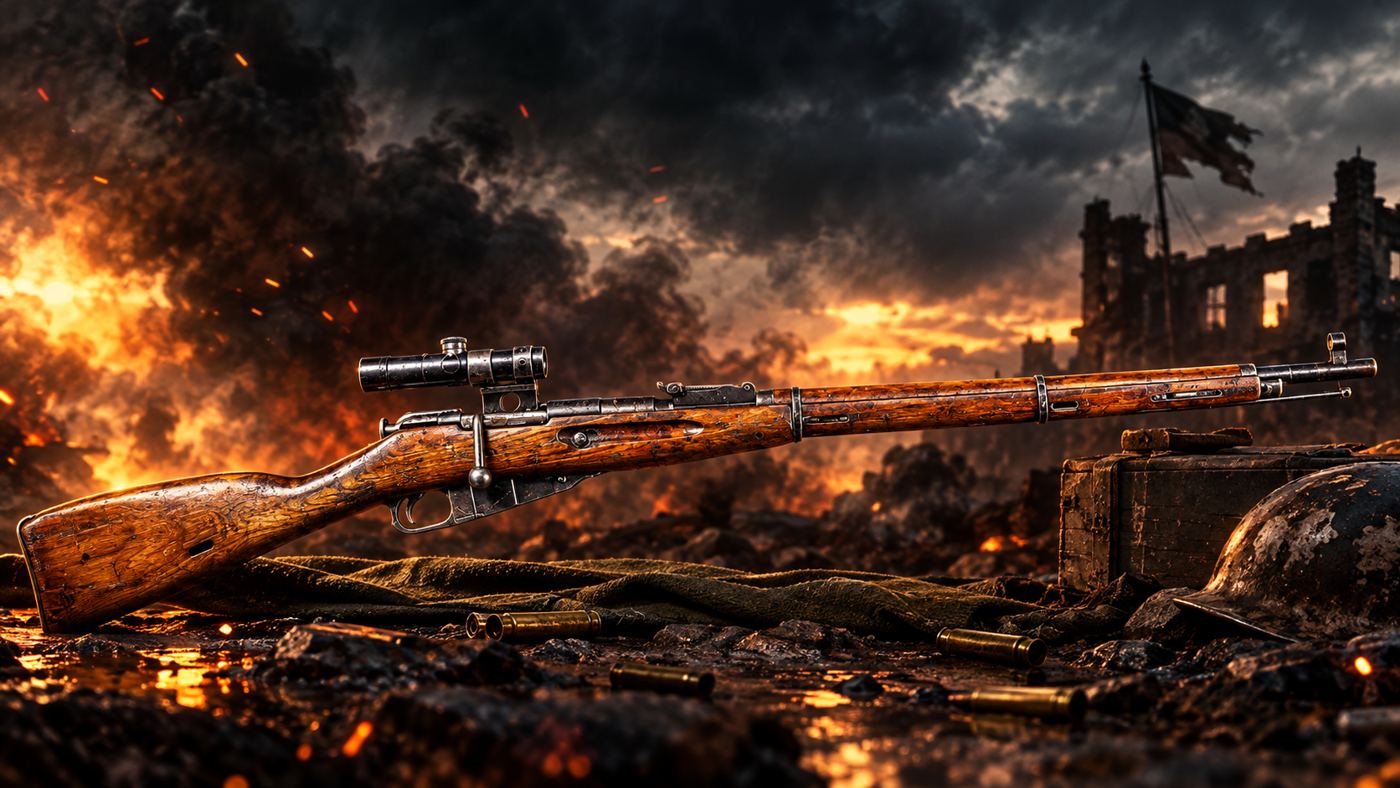
A Rifle in the Snow
Picture a winter morning on the frozen edge of a forest in Finland, in 1940. Temperatures are far below freezing. A man in a white smock lies motionless in the snow, a long rifle beside him with cloth tied around the muzzle to keep the snow from blowing. He has been lying there for hours. The rifle, a Mosin-Nagant, is not graceful or lightweight, but it is steady, it does not freeze, and it fires when he squeezes the trigger.
The Mosin-Nagant is one of the oldest military rifles that remained in serious use into the twenty-first century. It served under tsars, commissars, and revolutionaries. It was carried by conscripts and by some of the most celebrated snipers in history. It is rough, heavy, and unrefined, and it is hard to find a rifle that has seen more of the world.
Advertisement
Two Designers and One Compromise
In the 1880s, the Russian army wanted a modern magazine rifle to replace its single-shot weapons. Captain Sergei Mosin, a Russian officer, developed a bolt action, while the Belgian designer Léon Nagant contributed a magazine and feeding system. After competitive trials, the army adopted a combination of their ideas in 1891. The rifle was known officially as the three-line rifle, a reference to the old Russian measure of caliber, a "line" being about a tenth of an inch.
The name "Mosin-Nagant" was used abroad, though in Russia it was usually called simply the Mosin rifle. This was a little unfair to Nagant, and a little unfair to the factory workers in Tula, Izhevsk, and Sestroretsk who built it in staggering numbers.
Rough, Strong and Simple
| Specification | Details |
|---|---|
| Official name | 3-line rifle, Model 1891 (Mosin-Nagant) |
| Designers | Captain Sergei Mosin (Russia) and Léon Nagant (Belgium) |
| Adopted | 1891 by the Imperial Russian Army |
| Cartridge | 7.62×54mmR |
| Action | Bolt-action, 5-round internal magazine |
| Weight | About 4.0 kg |
| Length | About 1,300 mm (Model 1891); shorter M91/30 and carbines |
| Effective range | Over 500 m; sniper versions much farther |
| Production | Estimated 37 million or more |
The rifle fired the 7.62×54mmR cartridge, a rimmed round with plenty of power. The bolt was strong but sometimes stiff, especially when the rifle was new, and the long barrel gave it a nose-heavy feel. Soldiers were trained to keep the bayonet fixed at all times, because the rifle was zeroed with it attached. In practice, this made it even longer and unwieldy, and it turned every infantry fight into a close-up contest.
Its virtues were durability and accuracy. It tolerated mud, frost, and rough handling, and when well made its barrel could shoot remarkably straight. In 1930, the M91/30 modernized the design, and it became the standard Soviet rifle of the Second World War.
Wars of the Mosin
The Russo-Japanese War (1904–1905): The first great conflict in which the rifle was used.
The First World War: Millions of Russian soldiers carried it. Rifles were even made in the United States for Russia by Remington and Westinghouse.
The Russian Civil War: Used by many sides in the chaos after 1917.
The Winter War, 1939–1940: Finnish soldiers fought with captured and modified Mosins against the Soviet invasion, producing rifles famous for accuracy.
The Eastern Front, 1941–1945: The M91/30 was issued by the millions from Moscow to Stalingrad to Berlin.
Beyond: Later used in Korea, Vietnam, Afghanistan, and in many conflicts around the world, with surplus rifles appearing in unexpected places for decades.
The Snipers
The Mosin-Nagant's most famous chapters belong to snipers. Vasily Zaytsev, a shepherd's son from the Urals, became a legend in the ruins of Stalingrad, where Soviet records credit him with hundreds of kills. Lyudmila Pavlichenko, a former student of history, became one of the highest-scoring female snipers ever, credited with over 300 kills, and later toured the United States as a goodwill ambassador. And in Finland, Simo Häyhä, a quiet farmer who loved hunting, was credited with more than 500 sniper kills in about a hundred days during the Winter War.
Behind every legend was a person who went home to quiet rooms, haunted by what they had done.
Their stories show something important about the rifle. It was not special in design. It became remarkable through the discipline and patience of the people who used it.
Combat Effectiveness
Strengths
Extremely tough and reliable in extreme cold and dirt.
Powerful cartridge with excellent range.
Capable of fine accuracy, particularly in sniper versions with scopes.
Very cheap and easy to mass-produce.
Weaknesses
Heavy and long, awkward to carry and handle in tight spaces.
Stiff bolt and a rimmed cartridge that could cause feeding troubles.
Slow reloading with internal five-round magazine.
Outpaced by semi-automatic rifles in the later war years.
Legacy
A cartridge that refused to die: The 7.62×54mmR cartridge, introduced in 1891, is still used today in the Dragunov sniper rifle and the PKM machine gun, more than 130 years later.
Soviet design philosophy: The Mosin's long career established Russian traditions of rugged, simple, mass-produced military rifles, a philosophy later seen in the SVT-40 and the AK-47.
Sniper tradition: Soviet sniper doctrine grew from the Mosin's performance, producing the training and equipment that evolved into the SVD.
Collecting and sport: Surplus Mosins sold in huge numbers around the world, introducing generations of shooters to bolt-action rifles.
Conclusion: A Rifle That Outlived Its Empires
The Mosin-Nagant outlasted the empire that created it, the state that replaced it, and the wars that tested it. It is not beautiful, and it never needed to be. It was a tool that worked in the worst places, for the people who had no better choice, and in the hands of a few extraordinary people it became part of history.