The Kar98k: The Rifle in Millions of Hands
How a Nineteenth-Century Action Carried a World War
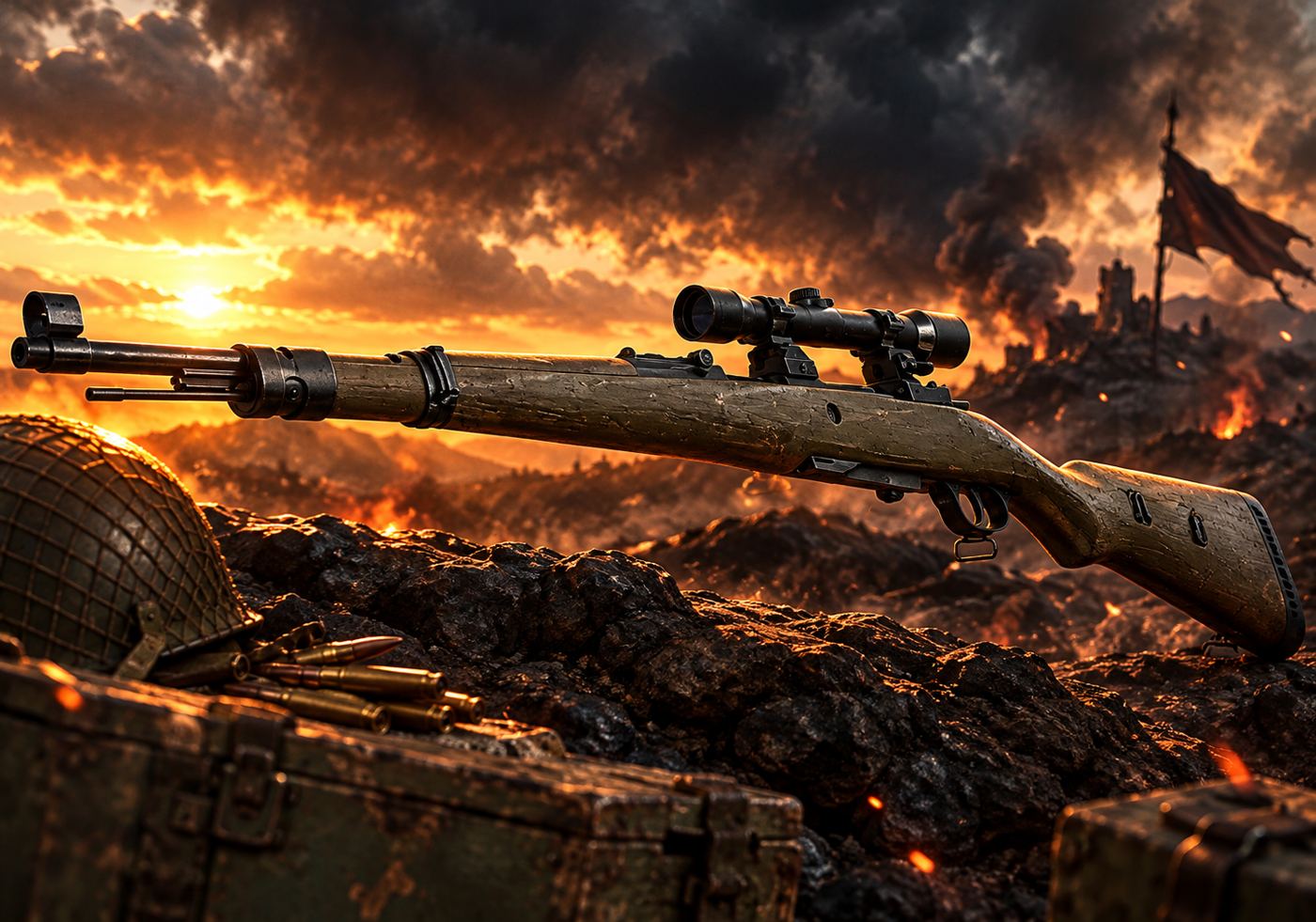
The Rifle Nobody Photographed
Famous weapons attract attention: the roaring machine gun, the giant cannon, the sleek assault rifle. The Karabiner 98 kurz rarely makes the cover. It looks plain, almost old-fashioned: a long wooden stock, a steel bolt you lift and pull back by hand, five rounds in the belly. Yet this rifle was carried by more German soldiers than any other weapon of the Second World War, and its design echoes in the hunting rifles and sniper rifles used today.
To understand the Kar98k, imagine the men who held it. An eighteen-year-old conscript from a Bavarian village receives his rifle in a barracks courtyard in 1940. It smells of oil and walnut wood, with a serial number stamped on the metal and a leather sling that hasn't yet been broken in. He is told to clean it every night, to protect it from dirt, to treat it as part of his body. For millions of young men, this was the first serious tool of adult life, and for many, the last.
Advertisement
A Rifle with a Long Memory
The Kar98k was not new. Its roots go back to 1898, when the German army adopted the Gewehr 98, built on the action designed by Paul Mauser. Mauser's genius lay in a few simple ideas: strong locking lugs at the front of the bolt, a reliable claw extractor that grips the cartridge rim firmly, and a clean, dependable feed system. The Gewehr 98 saw heavy service in the First World War and proved itself in the mud of the Western Front.
After Germany's defeat in 1918, the Treaty of Versailles limited the size and equipment of the army. German designers kept refining the Mauser rifle within these restrictions, producing shorter carbine versions. The result was the Karabiner 98 kurz, meaning "short carbine 98", adopted in 1935 as the standard infantry weapon as the country rearmed. It was shorter, handier, and easier to carry in vehicles and trenches than its predecessor, while keeping the legendary Mauser action.
Anatomy of a Workhorse
| Specification | Details |
|---|---|
| Official name | Karabiner 98 kurz (Kar98k) |
| Designer / maker | Mauser design (Paul Mauser's Model 98 action); produced by Mauser and many other factories |
| Adopted | 1935 by the German armed forces |
| Cartridge | 7.92×57mm Mauser (8mm Mauser) |
| Action | Bolt-action, internal 5-round magazine, loaded with stripper clips |
| Weight | About 3.9 kg (8.6 lb) |
| Length / barrel | About 1,110 mm / 600 mm |
| Effective range | Around 500 m with iron sights; further with a scope |
| Production | Roughly 14 million made between 1935 and 1945 |
Using it was a ritual. The soldier lifted the bolt handle, pulled it back, and pushed a five-round stripper clip into guides at the top of the receiver. With his thumb he pressed the cartridges down into the magazine, pulled out the empty clip, and pushed the bolt forward. Each shot required a similar motion: lift, pull, push, lower. A trained soldier could fire around 10 to 15 aimed shots a minute, but fatigue and stress made it harder.
The rifle was loved for its accuracy and strength. It could handle abuse, from the frozen steppe to the dusty North African desert, and it remained reliable if kept reasonably clean. Many soldiers developed a fondness for it, treating it as a loyal companion.
The Battles It Walked Through
Poland, 1939: The Kar98k was the main rifle of the German infantry when Germany invaded in September 1939.
Western Europe, 1940: Used across the Low Countries and France in 1940, in fast, mobile campaigns.
The Eastern Front: From 1941, millions of Kar98ks fought across the vast Soviet front, from the siege of Leningrad to Stalingrad and Kursk. Frozen oil, deep mud, and long retreats tested every part of it.
North Africa and the Mediterranean: It served in Rommel's Afrika Korps and in the campaigns in Italy and the Balkans.
The final defense of Germany: From Normandy to the Ardennes, and finally the fall of Berlin in 1945, German soldiers carried it to the end.
Who Carried It
The Kar98k was the weapon of the ordinary German infantryman, called the Landser in soldier's slang. Each rifleman typically carried around 60 rounds in leather pouches on his belt, arranged as clips ready for reloading. But the German squad was built around the machine gun, with the rifleman's role being to protect and support it. The rifle was a tool of precision and patience, not of overwhelming fire.
Specially selected marksmen used Kar98ks fitted with telescopic sights as snipers. Some became famous. Matthäus Hetzenauer, an Austrian mountain trooper, is credited with hundreds of confirmed kills, and Josef Allerberger, another Austrian, with over 250. Their stories are a reminder that the same rifle could serve as both a mass-produced infantry tool and a precision instrument, and that behind every number was a man living with what he had done.
To a rifleman on the Eastern Front, his rifle was not a symbol of an empire. It was the thing that stood between him and the dark.
Combat Effectiveness
Strengths
Excellent accuracy and range, easily sufficient for the typical engagement distances.
Robust, simple mechanism that tolerated hard use.
Powerful 7.92mm cartridge with strong penetration.
Adaptable: it could be fitted with scopes, grenade launchers, and bayonets.
Weaknesses
Slow rate of fire compared with semi-automatic rifles such as the American M1 Garand.
Only five rounds, with reloading by clip in the heat of battle.
Long, relatively heavy, and awkward in close combat inside buildings and trenches.
By late in the war, quality dropped as factories rushed production and used cheaper materials.
The Germans recognized these limits. They experimented with semi-automatic rifles such as the Gewehr 43 and, famously, the StG 44, which pointed toward the future. But the Kar98k remained the backbone of the infantry until the end.
Legacy: The Action That Never Died
American rifles: After the Americans found that the Mauser design outperformed their earlier rifles, the U.S. Army developed the M1903 Springfield, strongly influenced by the Mauser action. The U.S. later paid royalties to Mauser over patent issues.
Sporting rifles: The Winchester Model 70, often called "the rifleman's rifle", uses a Mauser-style controlled-round-feed action. Many modern hunting rifles descend from the same design.
Sniper rifles: The bolt-action sniper rifle remains a staple of modern armies, and the Mauser action is one of its most important ancestors.
After 1945: Captured and surplus Kar98ks were used in Czechoslovakia, Yugoslavia, Israel, and in colonial and post-colonial conflicts across Asia, Africa, and the Middle East. Many Yugoslav and Czech rifles of the Cold War were direct derivatives.
Conclusion: The Quiet Giant
The Kar98k was never glamorous. It had no futuristic shape, no famous nickname, no mythology. What it had was reliability, accuracy, and sheer numbers. In millions of hands, from schoolboys turned soldiers to veteran snipers, it did the work that wars always require.
Its greatest legacy may be quiet too: in a hunter's rifle on a mountain trail, in the bolt of a sniper's rifle, in a design so sound that it has outlived the world that created it.