The MG 42: Hitler's Buzzsaw
The machine gun that sounded like tearing cloth.
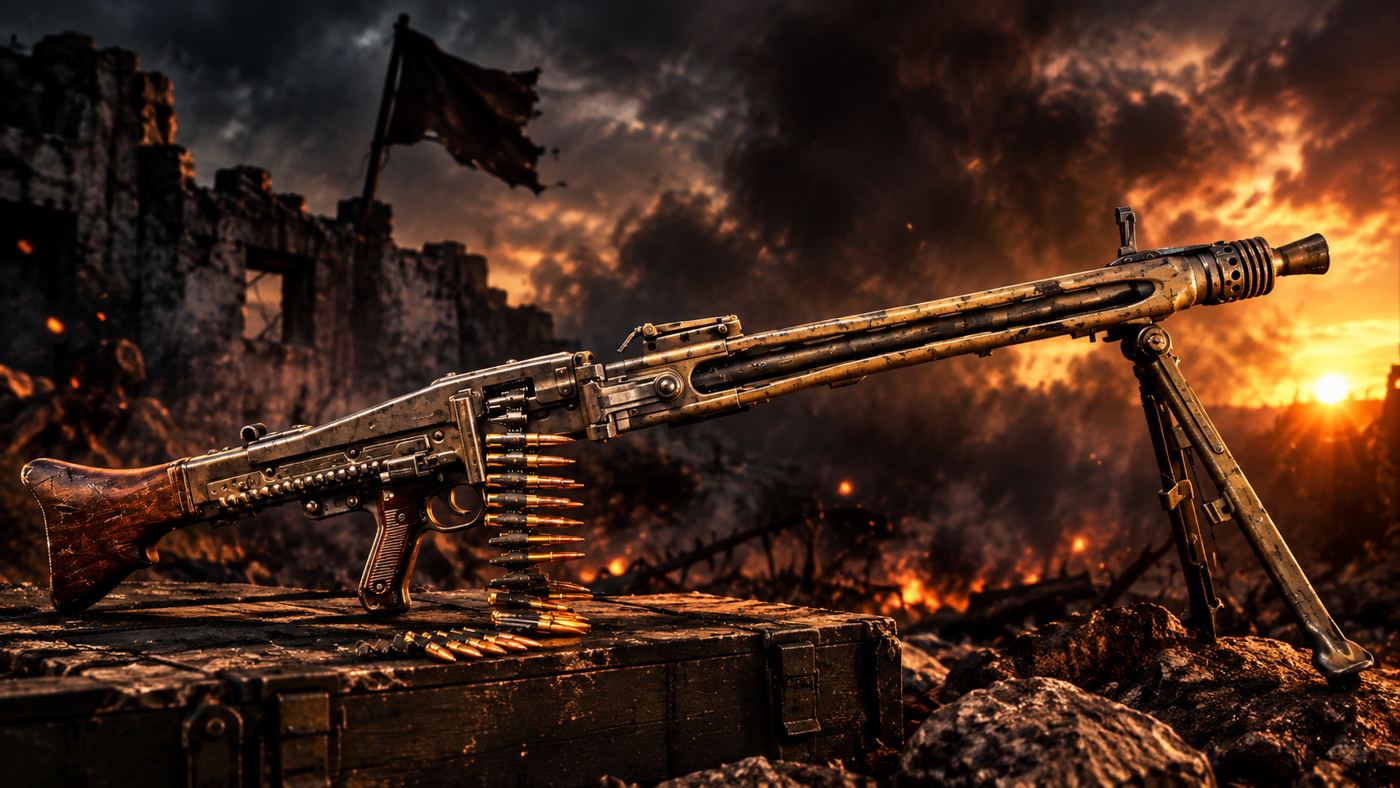
The Sound That Soldiers Never Forgot
Veterans who faced the MG 42 rarely talk about its appearance. They talk about its sound. Most machine guns of the era made a steady hammering, a slow drumbeat of shots. The MG 42 did not. Fired at its full speed, the shots blended into a continuous ripping noise, like heavy canvas being torn in half. American soldiers called it "Hitler's buzzsaw". Germans reportedly had their own nicknames, including the "bone saw" and "linoleum ripper".
Imagine a young American infantryman crouched in a Normandy hedgerow in the summer of 1944. His squad has been told to advance across a field. Then, from the far hedge, comes that terrible tearing sound, and the grass around him seems to jump. He does not know it, but at 1,200 rounds a minute, the gun on the other side can empty a 50-round belt in about two and a half seconds. All he knows is that he needs to get down, and that the men around him have gone very quiet.
Advertisement
A Gun Built for a Different Kind of War
The MG 42 was born from a practical problem. The German army already had an excellent machine gun, the MG 34, a refined and versatile weapon. But it was expensive and slow to build, made from carefully machined parts that required many hours of skilled labor. As the war grew larger and more demanding, Germany needed machine guns in far greater numbers, and it needed them quickly.
The answer came from an unlikely place: a modest engineer named Werner Gruner, working for a metal-stamping company called Großfuß. Gruner was not a traditional gunsmith. He was an expert in mass production. Rather than carving each part from solid steel, he designed the weapon around stamped and pressed sheet metal, simple welds, and rivets. The result was a gun that was cheaper, faster to produce, and easier to repair than its predecessor, without losing performance. The MG 42 entered service in 1942.
The approach foreshadowed what would come later: a weapon designed not only around how it fires, but around how it is made.
Inside the Buzzsaw
| Specification | Details |
|---|---|
| Official name | Maschinengewehr 42 (MG 42) |
| Designer / maker | Werner Gruner; produced by Großfuß and other firms |
| Adopted | 1942 |
| Cartridge | 7.92×57mm Mauser |
| Operation | Recoil-operated, roller-locked, belt-fed, air-cooled |
| Rate of fire | Roughly 1,200 rounds per minute (up to 1,500 in some conditions) |
| Weight | About 11.6 kg (bipod version) |
| Length | About 1,220 mm |
| Effective range | Around 1,000 m on bipod; farther on a tripod |
| Production | Several hundred thousand during the war |
The MG 42 fed ammunition from a belt, which could be linked to others for long bursts. Its recoil-operated mechanism used rollers to lock the breech, a design that was strong, simple, and fast. Its high rate of fire was a deliberate feature: it saturated an area with bullets and made it difficult for the enemy to move.
One of its cleverest features was the quick-change barrel. Firing at such speed, the barrel heated rapidly, so crews were trained to swap it for a fresh one in a matter of seconds. The gunner opened a latch on the side, pulled the hot barrel out of the rear, and slid a cool one in. It was a small mechanical idea with a big battlefield payoff.
It could be used on a light bipod for mobile infantry or on a heavier tripod for sustained, long-range fire. The machine gun team was usually a few men: the gunner, an assistant carrying ammunition and spare barrels, and others bringing up supplies.
Where It Fought
North Africa and the Eastern Front: It first appeared in combat in 1942, in the desert war and on the vast front in the east.
Italy: Used in defensive battles in the mountains of Italy, including the fighting around Monte Cassino, where well-sited machine guns made advances extremely costly.
Normandy and Western Europe: Placed in concrete positions and hedgerows, it shaped the experience of landing and advancing American, British, and Canadian soldiers.
The final campaigns: Used in the Hürtgen Forest, the Ardennes, and the defense of the Reich until the very end of the war.
The Men Behind the Gun
The MG 42 was the heart of the German infantry squad. Doctrine made the machine gun the primary weapon; riflemen were there to protect it and carry its ammunition. The gunner was often a calm, experienced soldier. His assistant fed belts and watched for the target. If the gunner fell, someone else picked up the weapon immediately.
That made the gun team a priority target. For enemy soldiers, silencing the machine gun often meant the difference between advancing and being pinned down. Accounts from both sides describe the intense, close relationship between these small crews, who relied on each other for survival.
A machine gun team is a tiny family, bound together by one heavy, noisy, glowing-hot piece of steel.
Combat Effectiveness
Strengths
Extreme rate of fire provided tremendous suppression and shock effect.
Reliable in cold, mud, and dust, thanks to generous tolerances.
Quick barrel change allowed sustained fire.
Cheap and fast to produce, with stamped construction.
Weaknesses
Very high fire rate consumed ammunition quickly and made the gun harder to control.
Barrels overheated rapidly during long bursts.
Heavy to carry for mobile infantry compared with lighter weapons.
Supply of ammunition and spare barrels became a problem as Germany's logistics collapsed.
Allied commanders studied it with a mix of respect and alarm. Many believed it had no equal on the battlefield, and it remains one of the most admired machine guns ever built.
Legacy: A Design That Never Retired
The MG 3 family: After the war, Germany developed the MG 1 and later the MG 3, direct descendants chambered in 7.62mm NATO. The MG 3 is still used by the German army and many other countries today.
International copies: Yugoslavia, Italy, Spain, Austria, Switzerland, and Pakistan, among others, produced or adapted versions of the weapon.
The M60 and FN MAG: The American M60 machine gun borrowed features from the MG 42, notably its belt-feed system. The Belgian FN MAG, one of the most widely used machine guns in the world, also combines an MG 42-style feed with a Browning-style gas system.
Stamped-steel manufacturing: The MG 42 demonstrated that sheet-metal stamping could produce a high-performance military weapon, influencing countless later firearms.
Conclusion: Efficiency Made Deadly
The MG 42 was a triumph of engineering for production: simple, rugged, cheap, and terrifyingly effective. It also stands as a reminder of how efficiency, applied to war, can produce suffering on a scale that is hard to imagine. For the soldiers who heard it, it was a sound they would never forget.
More than eighty years later, its descendants are still in service, a living link between the battlefields of the 1940s and the armies of today.