The M1 Garand: The Rifle That Changed Every Rifle After It
The Rifle That Taught a Nation of Farm Boys to Fire Eight Shots Without Thinking
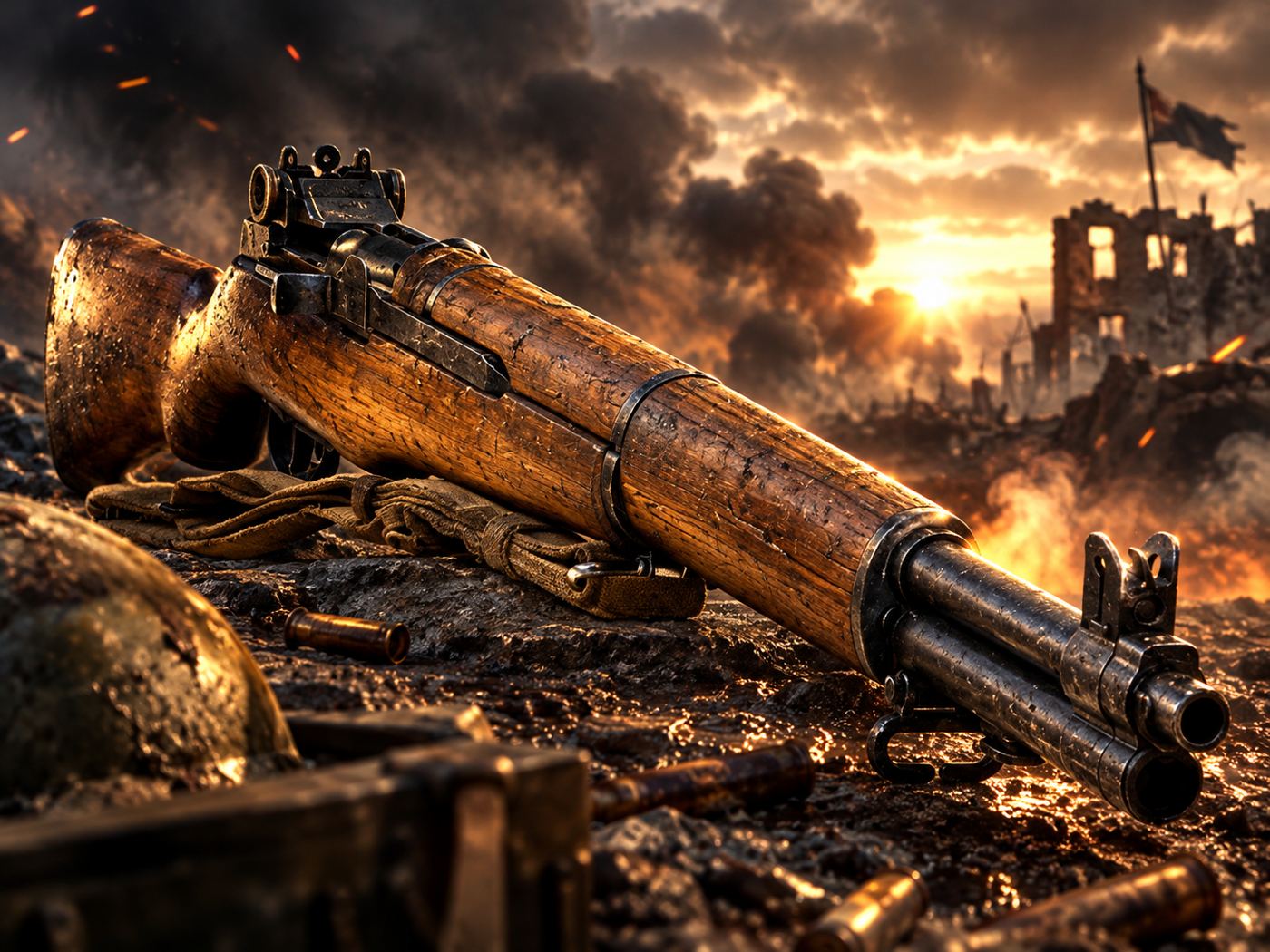
The Sound of Eight Shots and a Ping
Ask a veteran of the Second World War about the M1 Garand and many of them will do the same thing: they will make a small sound with their mouth. A sharp, bright "ping". It is the noise the rifle makes when the last of its eight rounds is fired and the empty steel clip springs out of the receiver and rings against the ground.
For millions of American soldiers, that sound was part of the rhythm of war. Eight shots, then a ping, then a scramble to push in a fresh clip. Imagine a nineteen-year-old from rural Ohio in 1944, kneeling in a muddy Normandy field. He has fired seven rounds in a few seconds. The eighth goes off, the clip rings out, and in the sudden quiet he has to decide whether to reload now or take cover. That moment, repeated by hundreds of thousands of men, is the human story of the Garand.
Advertisement
A Boy at a Mill, a Man at an Armory
The rifle's designer, John Cantius Garand, did not come from a world of generals and engineers. He was born in 1888 in a farming community in Quebec, Canada, and at about the age of eleven his family moved to Connecticut, where he went to work in a textile mill as a bobbin boy. He was small, quiet, and fascinated by machines. He spent his evenings in a shooting gallery, and later took a job as a machinist, learning the craft with his hands.
Garand became a United States citizen and, in 1919, joined the Springfield Armory in Massachusetts, the government's main rifle workshop. The Army wanted something revolutionary: a rifle in which each squeeze of the trigger fired a round and automatically loaded the next, so that a soldier could keep his eyes on the enemy instead of working a bolt. Garand worked on the problem for years, building and rebuilding prototypes.
Along the way, a famous decision nearly changed the rifle. Garand's early designs used a smaller, lighter cartridge called the .276 Pedersen. But in 1932, Army Chief of Staff Douglas MacArthur ruled against the change, in large part because the Army had enormous stocks of the old .30-06 ammunition and did not want to replace them. Garand redesigned his rifle to fit the larger round. In January 1936, the result was adopted as the United States Rifle, Caliber .30, M1.
Garand was a government employee, and he received no royalties for the rifle that would be built in the millions. Congress considered a bill to reward him, but it did not pass. He retired in 1953 and died in 1974, remembered more by soldiers than by the public.
How It Works
| Specification | Details |
|---|---|
| Official name | United States Rifle, Caliber .30, M1 |
| Designer | John C. Garand, Springfield Armory |
| Adopted | 1936 (production began 1937) |
| Cartridge | .30-06 Springfield |
| Action | Gas-operated, semi-automatic, rotating bolt |
| Feed | 8-round en-bloc clip, internal magazine |
| Weight | About 4.3 kg (9.5 lb) unloaded |
| Length / barrel | About 1,100 mm / 610 mm (24 in) |
| Effective range | Around 450 m with iron sights |
| Production | About 5.4 million, by Springfield, Winchester and others |
When a round is fired, part of the expanding gas is tapped from the barrel to push a piston and operating rod. The motion rotates the bolt to unlock it, ejects the empty case, cocks the hammer, and feeds the next cartridge from the magazine. The soldier only needs to squeeze the trigger again.
The most distinctive feature is the clip. Eight cartridges are held together in a steel clip, and the whole clip is pushed into the rifle from the top. When the last round is fired, the clip ejects with its famous ping. Reloading was quick, but the system had quirks. A careless soldier could catch his thumb in the closing bolt, an injury so common it earned a nickname: "Garand thumb". Almost every trainee learned the lesson once.
Into Battle
Before the war: Production started slowly, but by the time the United States entered the Second World War, the Garand was becoming the standard rifle of the Army.
The Pacific: Garands saw their first large-scale combat at Guadalcanal in late 1942 and then across the island campaigns of the Pacific, from the Philippines to Iwo Jima and Okinawa.
North Africa and Italy: From Operation Torch in North Africa through Sicily and Italy, American riflemen carried the Garand into mountains, rain, and mud.
Western Europe: On the beaches of Normandy, in the hedgerows, the Hürtgen Forest, and the Battle of the Bulge, the Garand was the everyday weapon of the American infantryman.
Korea and beyond: It remained in service in Korea, including the freezing fighting around the Chosin Reservoir, and was used in the early years of Vietnam and by many allied armies.
Who Carried It
The M1 was the rifle of the ordinary American draftee: farm boys, factory workers, shopkeepers, students. They arrived at training camps after a few weeks of civilian life, learned to strip, clean, and aim the rifle, and shipped out. A typical rifle squad had its riflemen armed with Garands, and the squad's automatic rifleman carried the BAR for heavier fire.
This had a quiet but important effect on tactics. A German rifleman using a bolt-action Kar98k had to work his bolt after every shot, while his American opponent could keep firing as fast as he could aim. In the chaos of short, sharp fights, that extra rate of fire often made a difference.
The Garand did not make soldiers braver. It made each brave act count for a little more.
General George S. Patton, who watched the rifle in action, wrote that it was "the greatest battle implement ever devised." It is a soldier's compliment, from a man who was not known for handing out compliments.
Combat Effectiveness
Strengths
Semi-automatic fire gave American infantry a major edge in volume of accurate fire.
Reliable in mud, sand, cold, and rain.
Powerful .30-06 cartridge with good range and penetration.
Accurate and sturdy, with variants for snipers such as the M1C and M1D.
Weaknesses
Heavy at about 9.5 pounds, tiring on long marches.
The 8-round clip could not easily be topped off during a fight.
The clip's ping was said to alert the enemy, though historians consider the danger overstated.
Cleaning and field-stripping were more involved than with simpler rifles.
Overall, it was widely seen as the best standard infantry rifle of its time. It proved that a semi-automatic rifle could be rugged and dependable enough for mass issue, a question many experts had doubted.
Legacy: The Rifle That Changed Every Rifle After It
The M14: The M14, adopted in 1959, was a direct descendant of the Garand's action, with a detachable 20-round magazine and selective fire. Its mechanism is clearly recognizable.
International versions: Italy converted and developed Garand-based rifles as the Beretta BM 59, and other countries produced their own versions.
Civilian rifles: The civilian M1A and the Ruger Mini-14 trace their action back to the Garand through the M14.
The end of the bolt-action era: Once armies had seen what a semi-automatic rifle could do, the old bolt-action rifle was finished. This paved the way for assault rifles such as the StG 44, the AK-47, and the M16.
A second life: Many Garands were later sold to American civilians through the Civilian Marksmanship Program, and the rifle is still shot in competitions today.
Conclusion: The Ping That Echoes
The Garand was designed by a man who started in a mill and was never rewarded with wealth. It was carried by ordinary young men who wanted, more than anything, to get home. It is not remembered as a glamorous weapon. It is remembered as a good tool, trusted by those who relied on it.
And in the quiet of a shooting range today, when a collector fires the last round and the clip rings out into the air, the sound still carries something of that world: eight shots, one ping, and a generation that learned to count on both.