The M3 "Grease Gun": The Philosophy of the Cheap, Good-Enough Gun
The Ugly Little Gun That Won Its Place by Being Cheap, Simple and Always There
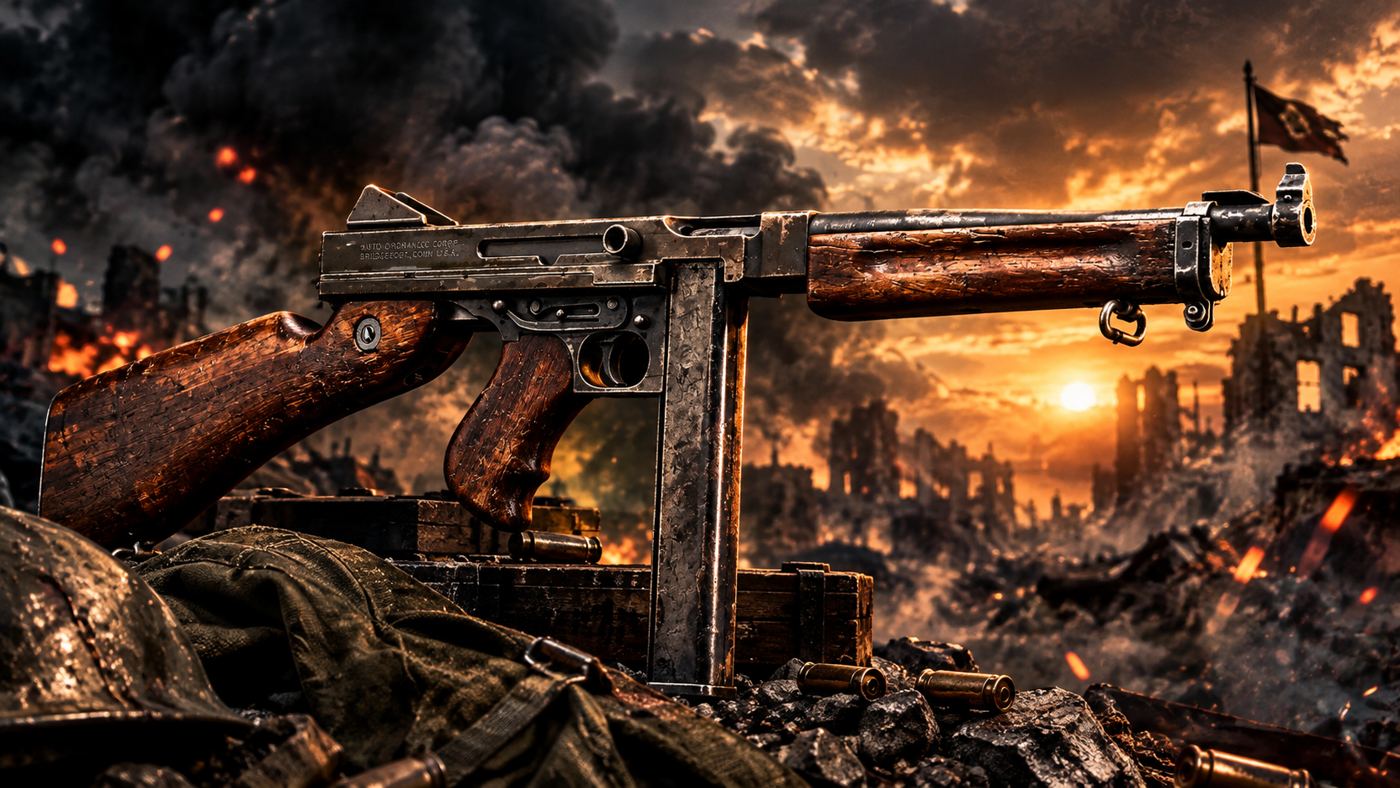
A Gun That Looked Like a Tool
When the first M3 submachine guns arrived in American units in 1943, many soldiers were unimpressed. It looked less like a weapon than something you would find in a garage. A blocky metal tube, a thin wire stock, a stubby barrel, and none of the polished wood or fine machining of the older Thompson. Someone, somewhere, said it looked just like the grease gun a mechanic uses to oil a truck. The nickname stuck, and so did the gun.
Imagine a tank commander in the winter of 1944, wedged inside a cramped steel turret near the Ardennes. There is no room for a rifle, and the Thompson is too long and heavy for the tight hatch. The M3 hangs on a hook within reach, folded small and light. When German infantry suddenly appear at the edge of a snowy field, he pulls it down, flips the stock out, and fires a short burst. It is not beautiful, but it works, and in that moment nothing else matters.
Advertisement
Born from a Cost Problem
The M3 began as an answer to a very practical question: how do you arm millions of soldiers when your best submachine gun costs too much? The Thompson, the famous "Tommy gun" of gangster films, was a wonderful weapon but a nightmare to produce. Its machined parts and wooden furniture made it slow and expensive, costing well over two hundred dollars each. The Army needed something it could build quickly, in vast numbers, without skilled gunsmiths.
Looking across the Atlantic, American planners saw the British Sten gun, a crude but effective weapon made of stamped metal and built for pennies. It proved the idea. In 1942 the U.S. Army asked for an American equivalent, and George Hyde, an experienced firearm designer, together with Frederick Sampson, produced the answer. It was adopted in December 1942 as the M3.
Production was handled by the Guide Lamp Division of General Motors in Anderson, Indiana, a company that had been making automobile headlights. In wartime, factories like it turned their machines to weapons. Many of the workers on the line, including large numbers of women who had taken the place of men gone overseas, built the guns that would equip a generation of soldiers. Each M3 cost around twenty dollars, a tenth of the Thompson. The same factory also produced a strange single-shot pistol called the FP-45 Liberator, designed to be dropped in bulk to resistance fighters behind enemy lines.
Inside the Grease Gun
| Specification | Details |
|---|---|
| Official name | United States Submachine Gun, Caliber .45, M3 (later M3A1) |
| Designers | George Hyde and Frederick Sampson |
| Maker | Guide Lamp Division of General Motors (Anderson, Indiana) and others |
| Adopted | December 1942; M3A1 improved version in 1944 |
| Cartridge | .45 ACP (a 9mm conversion kit also existed) |
| Operation | Blowback, open bolt, full-automatic only |
| Rate of fire | About 450 rounds per minute |
| Magazine | 30-round detachable box |
| Weight | About 3.7 kg (8.2 lb) unloaded |
| Length | About 570 mm stock retracted, 745 mm extended |
| Effective range | Around 90–100 m |
| Production | More than 600,000 |
The M3 was made largely from stamped sheet steel, welded and pressed into shape. It fired the heavy .45 ACP round from an open bolt: pulling the trigger released the bolt, which moved forward, picked up a cartridge, fired it, and kept going until the trigger was released. The slow rate of fire, around 450 rounds per minute, was a hidden advantage. It was easier to control, so a soldier could fire short bursts and hit what he aimed at.
The details show a designer thinking about the soldier, not just the factory. The wire stock could be pushed in to make the gun compact, and the stock itself doubled as a tool for removing the barrel and cleaning the weapon. A magazine loader was built in so the soldier did not need to carry extra gear. The early version was cocked by sticking a finger in a hole in the bolt, which was awkward, so the M3A1 introduced in 1944 added a simple cocking lever and a dust cover. A kit allowed the gun to be converted to fire 9mm ammunition, which helped when supplies were scarce.
Where It Fought
Normandy and Western Europe: The M3 reached units in 1943 and 1944, and was used by paratroopers and tank crews around D-Day and the campaign across France.
Battle of the Bulge: In the freezing forests of the Ardennes, tank crews and infantry used it for close defense.
The Pacific: It served in jungles and on islands, where compact, handy weapons were valuable.
Korea: The M3A1 remained in service during the Korean War, where cold weather again tested every weapon.
Vietnam: Special forces used suppressed versions for reconnaissance and quiet operations.
Late service: Remarkably, the M3A1 was still in the hands of some U.S. vehicle crews in the early 1990s, almost half a century after its introduction.
Who Carried It
The M3 was not the weapon of the typical rifleman. It was issued to people whose jobs made a full-size rifle impractical: tank and armored vehicle crews, truck drivers, paratroopers, mortar and machine gun teams, officers, military policemen, and patrol leaders. For these men, a compact weapon that could hang by the hatch or on a belt, ready for the unexpected, was worth more than range or elegance.
It was the weapon you grabbed when the day went wrong: the ambush, the roadblock, the corner you did not expect.
Resistance fighters and special units also valued its simplicity. A gun that could be handed to a novice, taught in a few minutes, and repaired with basic tools fit the needs of irregular warfare.
Combat Effectiveness
Strengths
Extremely cheap and fast to produce in large quantities.
Heavy .45 bullet delivered strong stopping power at short range.
Slow fire rate made it controllable.
Compact, with a collapsible stock that suited vehicles and paratroopers.
Simple to maintain and field-strip.
Weaknesses
Short effective range of around 100 meters, with limited accuracy.
Thin sheet-metal magazines could be damaged or jam if mistreated.
Open-bolt design was less accurate than rifles and sensitive to dirt entering the action.
Looked crude, and some soldiers never fully trusted it at first.
Its reputation improved with experience. Soldiers who used it came to respect its reliability, and many veterans remember it with real affection.
Legacy: The Philosophy of the Cheap, Good-Enough Gun
Stamped-steel manufacturing: The M3 proved that stamped sheet metal could replace machined steel and wood without losing combat value. Alongside the German MP 40 and the British Sten, it helped make this approach standard worldwide, from the AKM to the Uzi and many later designs.
The collapsible stock: Its collapsible wire stock became a common feature of compact weapons. Folding and telescoping stocks are now standard on carbines and submachine guns.
Mass-production thinking: The M3 and the Sten popularized the idea that a weapon could be inexpensive and even partly disposable. Later submachine guns around the world, from the Israeli Uzi to many cheap designs, followed the same logic.
The modern compact weapon: Today the role of the submachine gun has been largely taken by short-barreled carbines and compact personal defense weapons, but the idea of a small, light, easily carried automatic weapon for vehicle crews and support troops comes straight from guns like the M3.
Conclusion: The Gun Nobody Fell in Love With, and Everybody Came to Trust
The M3 never had the glamour of the Thompson or the legend of the Garand. It was built in a car-parts factory, by workers who had never expected to make guns, for soldiers who just wanted something that would work. It was plain, cheap, and slightly comical to look at. And it did its job.
There is something quietly fitting about that. In a war defined by enormous machines and grand strategy, one of the most useful tools turned out to be a stamped-metal gun that looked like a garage tool, and which millions of ordinary people helped to build.