The Lee-Enfield: The Reliable Old Friend
The Rifle That Fired So Fast Its Enemies Thought It Was a Machine Gun
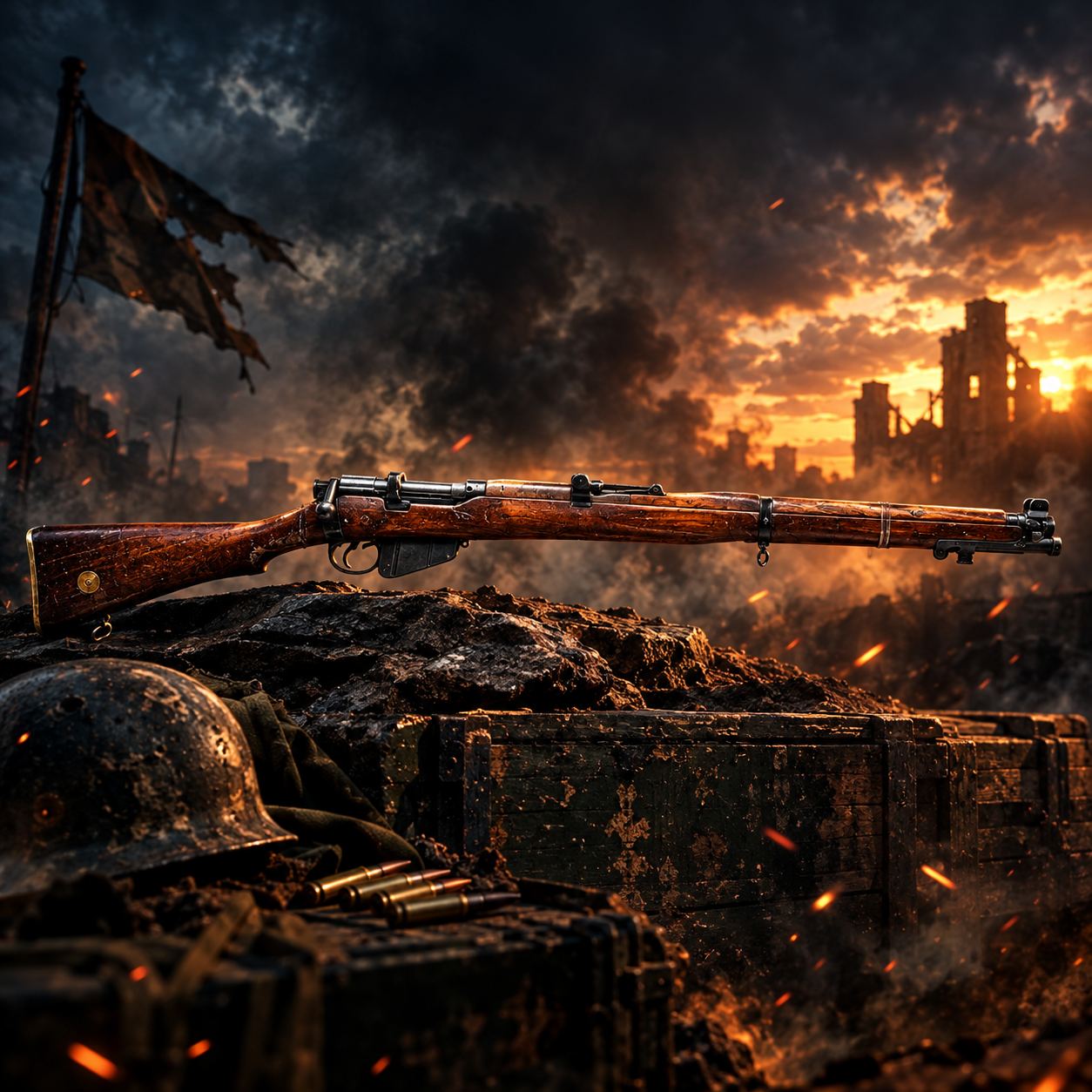
The Mad Minute
In the early years of the twentieth century, every British infantry recruit faced a test known as the "mad minute". Standing at a firing line, he had to put at least fifteen aimed rounds into a target the size of a dinner table, three hundred yards away, in sixty seconds. Not many armies in the world asked this of their soldiers, and fewer rifles could answer.
Imagine a nervous private, perhaps twenty years old, hands slippery with oil, the smell of gunpowder in his nose, working the bolt as fast as he can. Lift, pull, push, down, fire. He is not thinking about empire or strategy. He is thinking about the sergeant behind him who is counting hits. That small, repetitive drill is the human heart of the Lee-Enfield story, because the rifle was designed around the hands of the person using it.
Advertisement
An Inventor Who Crossed Three Countries
James Paris Lee was born in Scotland in 1831, raised in Canada, and settled in the United States. He was a gunsmith with a simple obsession: make a magazine rifle that a soldier could fire quickly and keep loaded. His great contribution was a detachable box magazine feeding the rifle from below, a layout that looks completely normal today but was revolutionary then.
The British army adopted a Lee rifle in 1888 as the Lee-Metford, named for the rifling designed by William Metford. When smokeless powder arrived, the Metford grooves wore out too quickly, and the Royal Small Arms Factory at Enfield designed new rifling. The result, from 1895, was the Lee-Enfield. In 1903 it became the shorter, handier Short Magazine Lee-Enfield, the SMLE, the form of rifle most people picture. In 1941 the simplified No. 4 rifle arrived for the Second World War.
Why It Was So Fast
| Specification | Details |
|---|---|
| Official names | Lee-Metford (1888), Lee-Enfield (1895), SMLE Mk III (1907), No. 4 Mk I (1941) |
| Designers | James Paris Lee (action and magazine); Royal Small Arms Factory, Enfield (rifling) |
| Cartridge | .303 British |
| Action | Bolt-action, rear-locking bolt |
| Magazine | 10 rounds, loaded from 5-round chargers |
| Weight | About 3.9–4.1 kg |
| Length | About 1,130 mm (SMLE) |
| Effective range | Around 500 m with iron sights |
| Production | Roughly 17 million over its history |
Two features made the Lee-Enfield exceptional. First, the bolt locked at the rear, which put the handle close to the shooter's hand and made the stroke short and smooth. Second, it held ten rounds, double the capacity of many rivals, loaded in two quick pushes from five-round chargers. A well-trained soldier could keep up a stream of aimed fire that astonished enemies.
In 1914, as the small British Expeditionary Force met the German army at Mons, legend has it that German officers reported they had been facing machine guns. In fact, they were facing riflemen. The story may have been polished in the retelling, but it captures something true: trained Lee-Enfield shooters could fire like a much bigger force.
A Rifle That Followed the Flag
The Boer War era: Fired in colonial campaigns in South Africa and Asia in the early years.
The First World War: The SMLE was the standard rifle in the trenches. British, Canadian, Australian, New Zealand, and Indian soldiers carried it at Gallipoli, the Somme, and Passchendaele.
The Second World War: From Dunkirk to North Africa, from Burma to Normandy, the No. 4 and its jungle-carbine variant served across the Commonwealth.
After 1945: Used in Korea, in Malaya, during the Mau Mau Uprising in Kenya, and in many postwar conflicts across Asia and Africa.
A very long life: Indian factories continued to produce versions for decades, and some police forces still use them.
The Soldiers Behind the Rifle
The Lee-Enfield belonged to a distinctive kind of soldier: the long-service professional of the old army and, later, the citizen-soldier of the dominions. Young men from Australia and New Zealand carried it ashore at Gallipoli in 1915. Canadian riflemen carried it at Vimy Ridge. Indian soldiers carried it in every theater of both world wars. For many of them, it was the object they knew best, cleaned a thousand times, and sometimes carved their names into.
A rifle is never just a rifle to the man who has carried it for three years. It is a clock, a pillow, a friend, and an enemy.
Combat Effectiveness
Strengths
Very fast rate of aimed fire for a bolt-action rifle.
Ten-round magazine gave a major firepower advantage.
Strong, forgiving mechanism in mud, dust, and cold.
Smooth bolt operation that suited intensive training.
Weaknesses
The .303 cartridge was a rimmed design, less convenient than later rimless rounds.
Rifles were heavy and long, tiring on marches and awkward in confined spaces.
Eventually outclassed by semi-automatic rifles such as the American M1 Garand.
In the hands of trained men, it was a superb weapon. Its decline came not from failure but from the arrival of something new.
Legacy
The box magazine: Lee's detachable box magazine is the ancestor of the magazines in nearly all modern rifles and carbines.
Marksmanship culture: The Lee-Enfield's reputation helped set the standard for fast, aimed bolt-action shooting, and sniper versions such as the No. 4 (T) served well into the 1950s.
Shorter rifles: The Jungle Carbine and other short versions showed the benefits of handy, shorter rifles, a trend that led directly to modern carbines.
Sporting use: Many civilian hunting rifles and target rifles are built on Lee-Enfield actions or inspired by them.
Conclusion: The Reliable Old Friend
The Lee-Enfield is remembered the way people remember an old friend: not for dazzle but for dependability. Through two world wars and countless smaller conflicts, it did what it was asked, in the hands of men who had practiced until it felt like part of them.